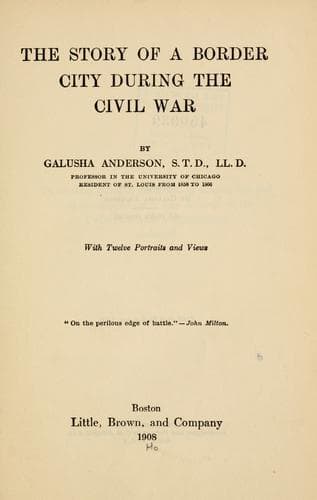
The story of a border city during the Civil WarAnderson, Galusha
History
The story of a border city during the Civil War
Anderson, Galusha
Missouri -- History -- Civil War, 1861-1865; Saint Louis (Mo.) -- History -- Civil War, 1861-1865
In the meantime, the clear-sighted, intrepid Lyon at Springfield was
left to shift for himself. He concluded that retreat would be hazardous,
if not absolutely destructive, in the face of a hostile force nearly
three times as great as his own, and unhesitatingly decided to take the
initiative instead of simply standing on the defensive. His matured
purpose was quickly executed. The army of Price and McCulloch was at
Wilson’s Creek, about nine or ten miles south of Springfield. He
determined to move upon it in two columns, the first under himself, the
second under Colonel Siegel. The advance was to begin about sunset of
the 9th; the attack was to be made at daylight the next morning. Having
given his orders, he calmly wrote General Fremont the following
memorable letter. It was his last.
“I retired to this place, as I before informed you, reaching here on the
5th. The enemy followed to within ten miles of here. He has taken a
strong position and is recruiting his supply of horses, mules, and
provisions, by forays into the surrounding country: his large force of
mounted men enabling him to do this without much annoyance from me. I
find my position extremely embarrassing, and am at present unable to
determine whether I shall be able to maintain my ground, or be forced to
retire. I can resist any attack from the front, but, if the enemy were
to surround me, I must retire. I shall hold my ground as long as
possible, though I may, without knowing how far, endanger the safety of
my entire force, with its valuable material, being induced, by the
important considerations involved, to take this step. The enemy showed
himself in considerable force yesterday five miles from here, and has
doubtless a full purpose of attacking me.”[51]
It has remained for an officer of the Confederate army, Thomas L. Snead,
in his comment on this letter to utter perhaps the most eloquent eulogy
pronounced on General Lyon. “Not one word about the desperate battle
that he was to fight on the morrow; not one fault-finding utterance; not
a breath of complaint! But true to his convictions; true to his flag;
true to the Union men of Missouri who confided in and followed him; true
to himself; and true to duty, he went out to battle against a force
twice as great as his own, with a calmness that was as pathetic as his
courage was sublime.”[52]
Public-domain text, read in full here on John Shaqi.
Reviews
Reviews
No reviews yet
Be the first to share your thoughts on this work.
Elsewhere in the archive
Join the Discussion
Join the discussion
Sign in to leave a comment or review.
Sign InorCreate an account