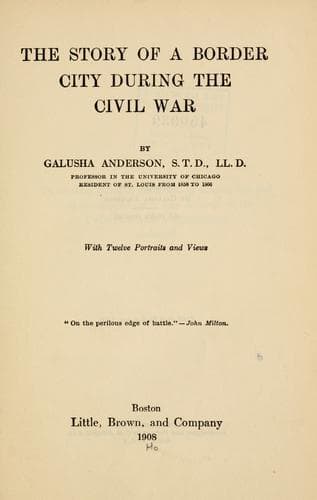
The story of a border city during the Civil WarAnderson, Galusha
History
The story of a border city during the Civil War
Anderson, Galusha
Missouri -- History -- Civil War, 1861-1865; Saint Louis (Mo.) -- History -- Civil War, 1861-1865
The general directed another manifesto against the fair sex, who, having
the courage of their convictions, and relying on the courtesy and
gallantry universally shown in our country to women, had vauntingly
carried the Confederate flag on their persons, and at times had waved it
to their rebel friends, who were confined in the Gratiot Street prison.
He ordered their arrest. Some of them were apprehended and imprisoned.
One, who had been a prominent worker in my own church and congregation,
having been found guilty of conveying important information to the
enemy, was banished from the city and State. Having acted the part of a
spy, her punishment was exceedingly mild. If a man had committed the
same crime he would have been shot or hung. In fact General Halleck had
already ordered that all persons found within the Federal lines, giving
aid to the rebels, be treated as spies, arrested and shot. But previous
good character and deference to sex saved the guilty woman from a fate
so dire.
Other women of high social position, whose homes were outside the city
in the State, had fled from the disorder and violence of their
neighborhoods to St. Louis for safety. Generously protected within our
gates and by our army, some of them hatched and executed schemes to aid
the Southern Confederacy, to overturn the very government under whose
sheltering wings they were abiding in security. While the disloyal deeds
of many of them remained undiscovered, and they continued during the
whole period of the war to dwell unmolested under the flag that they
hated and clandestinely plotted to destroy, others, betrayed by their
over-bold acts of disloyalty, were by our general remorselessly banished
from our city. He sent them back to their homes in the State, around
which the swirling tides of war still swept. Some prominent loyal men
pleaded for them, but pleaded in vain. The general unflinchingly did his
duty as he saw it.
Nor did the disloyal press elude his eye, or escape his retributive
hand. By his direction the provost-marshal general ordered all
newspapers throughout the State to furnish him a copy of each issue. The
penalty for any failure to obey this drastic mandate was suppression or
confiscation.
Public-domain text, read in full here on John Shaqi.
Reviews
Reviews
No reviews yet
Be the first to share your thoughts on this work.
Elsewhere in the archive
Join the Discussion
Join the discussion
Sign in to leave a comment or review.
Sign InorCreate an account