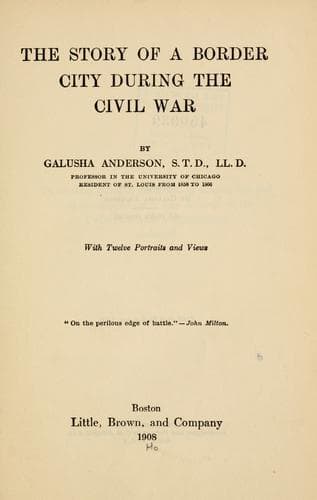
The story of a border city during the Civil WarAnderson, Galusha
History
The story of a border city during the Civil War
Anderson, Galusha
Missouri -- History -- Civil War, 1861-1865; Saint Louis (Mo.) -- History -- Civil War, 1861-1865
This want of coin for a time also seriously interfered with travel in
our city. Happy were those who had horses and carriages; but most of us
must either go afoot, or take the horse-cars. Nobody then had so much as
dreamed of either the grip-car or trolley. But the vexed question was,
how could we pay our fare? Neither we nor the conductor had any change
and none was to be had. But necessity is the mother of invention; and
necessity for a considerable period drove us to pay our horse-car fare
in postage-stamps. But in summer the weather in St. Louis is often very
warm, sometimes sissing hot. On such days we found the requisite stamps
glued to our pocketbooks, or, if folded in our vest pockets, melted into
a glutinous mass. How we then worked to separate the sticky things so as
not to destroy them! How dilapidated they were when finally disengaged
from their adhesive fellows! In getting them ready for service, some
lost patience and expressed themselves in words that would not pass
muster in polite society; while others differently made up broke out
into laughter at the comicality of the whole thing.
Soon the government came to our aid by issuing in March, 1862, “postage
currency.” Five, ten, twenty-five and fifty cent notes abounded. Postage
stamps as currency then disappeared from the marts of retail trade, and
no longer pestered street-car passengers and conductors. These tiny
notes of green paper were now doing the usual work of the silver coins
that had gone into hiding. And a year later, in March, 1863, the
government, still seeking to help the people in that time when metallic
currency was no longer in evidence, issued paper “fractional currency.”
For greater convenience notes of three and fifteen cents were issued in
addition to those of the “postage currency.”
These small notes were generally called shinplasters. How fine they
looked as they came crisp and clean from Washington; but in a dusty,
smoky city like ours, constantly passing from hand to hand, they soon
became worn, tattered, almost illegible, and unspeakably nasty. But few
seemed to care for this. These begrimed notes met our necessities in
barter; and as to any inconvenience or repulsiveness that was accounted
for and cheerfully endured as a part of the war.
The government, in order to raise money to meet its necessities, issued
seven per cent. bonds of fifty and one hundred dollars. I invested five
hundred dollars in these securities, and to my astonishment was reported
in the papers and personally congratulated on the street as having done
a patriotic act. I had not looked upon it in that light. But the
incident shows that very many in St. Louis then thought the stability of
our Republic so precarious that investing money in her bonds at seven
per cent. was regarded as an act of patriotic self-sacrifice. That is a
sort of self-sacrifice that hosts of men would be glad to indulge in
now.
Public-domain text, read in full here on John Shaqi.
Reviews
Reviews
No reviews yet
Be the first to share your thoughts on this work.
Elsewhere in the archive
Join the Discussion
Join the discussion
Sign in to leave a comment or review.
Sign InorCreate an account