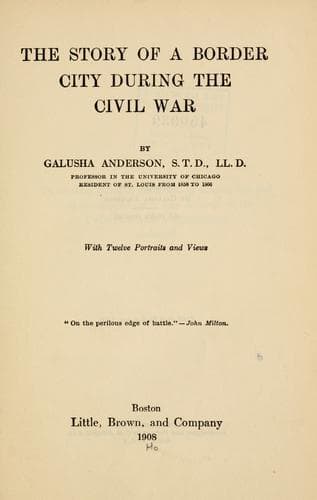
The story of a border city during the Civil WarAnderson, Galusha
History
The story of a border city during the Civil War
Anderson, Galusha
Missouri -- History -- Civil War, 1861-1865; Saint Louis (Mo.) -- History -- Civil War, 1861-1865
In closing this inadequate sketch of our hospitals, I wish gratefully to
call attention to the fact that they were an immeasurable blessing to
St. Louis. They marvellously developed the benevolence of the city. By
them scores of men and women were lifted up out of their selfishness. In
ministering to those in need they forgot themselves. In spite of all the
evils of the war, it led more people in our city to live in some measure
the life of Christ than any other influence had ever before done. The
best exhibition of Christianity ever witnessed within our gates was that
band of devoted workers seen every day and night in the camps and
hospitals. Hundreds of women whose Christian activities had never before
gone beyond the family or the individual church, now like their divine
Lord went about doing good. Like the good Samaritan, they had compassion
upon all that they found in distress, irrespective of nationality or
creed.
CHAPTER XXII
THE MISSISSIPPI VALLEY SANITARY FAIR
As the war went on, the demands on the Western Sanitary Commission
became enormous. At the close of 1863 and the beginning of 1864 the
Commission found its treasury well nigh empty. Something must be done to
replenish it. After careful deliberation, the Commission decided to hold
a fair, believing that thereby it could secure the funds required for
its vastly important work. So on February 1st, 1864, it inaugurated this
popular movement.
General William Starke Rosecrans, who, in January, had succeeded General
Schofield in command of the Department of Missouri, was made president
of the Fair. From the start the project was popular. In St. Louis the
people took hold of it with marked enthusiasm. They were ready to work
and give to make it a success. That thoroughness might characterize all
that was done they carefully organized their forces. They divided among
themselves the multifarious tasks to be performed. They appointed
committees to look after every important detail, and to report to the
central authority. So amid the multiplicity of things there was unity
and order. It was exhilarating to see a great community so stirred up in
the doing of a patriotic and benevolent work, that, for a time, all
conventionalities of society and distinctions of race or creed were
forgotten. Protestant and Catholic, Jew and Gentile, Europeans and
Americans, whites and blacks met, and elbowed, and emulated each other
in working for the soldiers of the Union.
Public-domain text, read in full here on John Shaqi.
Reviews
Reviews
No reviews yet
Be the first to share your thoughts on this work.
Elsewhere in the archive
Join the Discussion
Join the discussion
Sign in to leave a comment or review.
Sign InorCreate an account