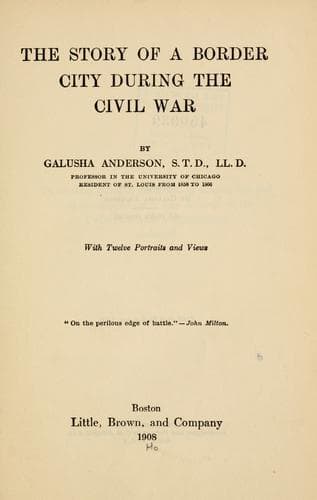
The story of a border city during the Civil WarAnderson, Galusha
History
The story of a border city during the Civil War
Anderson, Galusha
Missouri -- History -- Civil War, 1861-1865; Saint Louis (Mo.) -- History -- Civil War, 1861-1865
But a work so great could not be done by our city alone, however willing
and diligent we might be; so, the Commission appealed for help to the
people of other cities and States. The response was prompt and
exceedingly generous. Money and large consignments of useful articles to
be sold at the Fair came from Boston, Salem, Worcester, Providence, New
Bedford, New Haven, New York, Brooklyn, Philadelphia, Nevada (then a
remote mining territory), England and Germany. Other givers also in
justice should be mentioned, but we name these merely to show how
cosmopolitan the donations to the Fair were. Helping hands were
stretched across the sea to us. Wars on behalf of the oppressed are wars
of progress, and make kin the lovers of righteousness in all the
nations.
But among the givers St. Louis herself ranked with the first. Her
business men contributed large amounts of goods; her families, vast
numbers of salable articles made in their homes; her artists and lovers
of art, valuable paintings, etchings, and engravings; and some liberally
gave money.
When the Fair opened on May 17th, there was in its treasury two hundred
thousand dollars in cash, which had been contributed by men in St. Louis
and in different parts of the Union.
The building for the Fair was on Twelfth Street. It was five hundred
feet long and extended from St. Charles to Olive Street. It had wings on
Locust Street, each one hundred feet by fifty-four. In the centre of the
building was an octagon seventy-five feet in diameter and fifty feet
high. This octagon was lavishly decorated with mottoes, national
banners, battle trophies, such as flags and weapons captured from the
enemy, and arbors of evergreens and flowers.
The building was divided into various departments. One department was
devoted to the refugees. Since they were a special object of charity and
so much was needed adequately to meet their wants, and the sympathies of
so many were specially drawn out to them, it seemed quite necessary to
devote a generous space in the building to their particular benefit. The
same was true of the freedmen, and a department was assigned to those
who were especially interested in meeting their wants and promoting
their general welfare.
The Germans, being so large a part of our population, and so ardently
devoted to the maintenance of the Union, were given a large space in the
building, where they patriotically sold lager beer, and a host of people
patriotically drank it. Very many connected with the Fair strongly
objected to this, but being in the minority were unable to prevent it.
Public-domain text, read in full here on John Shaqi.
Reviews
Reviews
No reviews yet
Be the first to share your thoughts on this work.
Elsewhere in the archive
Join the Discussion
Join the discussion
Sign in to leave a comment or review.
Sign InorCreate an account