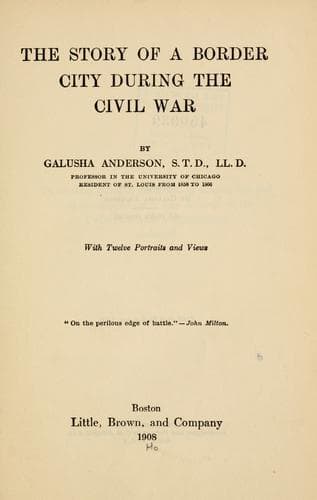
The story of a border city during the Civil WarAnderson, Galusha
History
The story of a border city during the Civil War
Anderson, Galusha
Missouri -- History -- Civil War, 1861-1865; Saint Louis (Mo.) -- History -- Civil War, 1861-1865
But in this invasion the rebel general was in some ways largely
successful. He killed and wounded very many of our troops. During this
campaign, though it lasted only a few days, there were more than forty
skirmishes and about fifteen battles, some of them of considerable
dimensions. Many places, either utterly without defence, or inadequately
defended, were temporarily occupied, and plundered. Houses of Union men
were burned. Railroad tracks were torn up, and the rails twisted and
destroyed. Bridges, depots and warehouses were reduced to ashes. Horses,
mules and wagons in large numbers were carried away. Vast quantities of
commissary stores were ruthlessly gathered for the Confederate army.
Price, in his report of this campaign, claims that he destroyed full ten
million dollars worth of property. Perhaps that is an exaggeration; but
he marched by a circuitous route from one end of our State to the other,
devastating a strip of territory about twenty miles wide.
He, to be sure, lost heavily. Ten pieces of his artillery, two stand of
colors, large numbers of wagons, mules and small arms, and nearly two
thousand prisoners were captured by the Federals. Many of his men were
slain in battle. He had also been compelled in his flight to burn very
many of the wagons that he had confiscated, and to destroy much of his
ill-gotten plunder.
Moreover, he had utterly failed, politically. He anticipated the
uprising of the “Order of American Knights,” fully twenty-five thousand
in number, and that most of them would join his army; he also expected
to take St. Louis and swing our State into the Southern Confederacy;
march into Illinois, where, re-enforced by the one hundred fifty
thousand Knights of that State, and greeted by the Knights from Indiana
and Ohio, with Vallandigham at their head, he hoped to establish a
Northwestern Confederacy and put a stop to the war, which was being
waged for the maintenance of the Union. But divine Providence had
decreed that this audacious scheme of rebels and copperheads should
never be realized. The effort to make the airy fabric of that dream a
reality had been attended with devastation, misery and blood, and had
ended in inglorious defeat.
But one sad outcome of the devastating march of Price’s army was patent
to every eye. Before it Union men with their families fled for their
lives. Many of them hastily left their homes at night, lighted on their
way by their flaming houses. Avoiding their pillaging foes, they made
their way to St. Louis. They came in great numbers, and like the
refugees that preceded them, were kindly received and abundantly cared
for.[112]
CHAPTER XXIV
NEGRO SCHOOLS
Public-domain text, read in full here on John Shaqi.
Reviews
Reviews
No reviews yet
Be the first to share your thoughts on this work.
Elsewhere in the archive
Join the Discussion
Join the discussion
Sign in to leave a comment or review.
Sign InorCreate an account