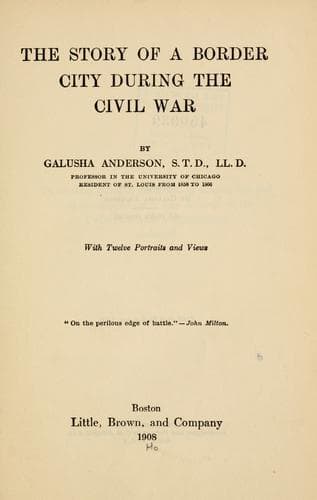
The story of a border city during the Civil WarAnderson, Galusha
History
The story of a border city during the Civil War
Anderson, Galusha
Missouri -- History -- Civil War, 1861-1865; Saint Louis (Mo.) -- History -- Civil War, 1861-1865
Before the last invasion of our State by Price, a few of us became
deeply interested in the education of the colored children of our city.
No public school was open to them. Although the negroes of St. Louis
owned taxable property, assessed year by year at a valuation of hundreds
of thousands of dollars, and had long paid annually no inconsiderable
school tax, it had been used for the education of white children alone.
This rank injustice, one of the many shameful wrongs of chattel slavery,
led the colored people to establish in different parts of the city a few
private schools for the education of their own children. By the flocking
of contrabands into St. Louis the demand for colored schools had
steadily grown more imperative. But these schools, founded and conducted
by colored teachers, were of a very low grade. They were worthy of
hearty commendation, as earnest efforts on the part of those who, though
brought up in ignorance, desired better things for their children than
they themselves had known. This ignorance yearning for knowledge, this
stretching out of black hands toward the light, was an appeal too
eloquent to be resisted. A goodly company of us determined to do what we
could to lay the foundation for the future education of our colored
population. It was already pretty clear that they were to be
enfranchised citizens, and would need greater intelligence to enable
them to discharge creditably their obligations to the community and the
State.
We saw at a glance what they needed was better schools and more of them.
Larger and more cleanly rooms, more and better elementary books, and
above all more thoroughly trained teachers were absolutely necessary in
order to secure results even moderately satisfactory. To accomplish
this, two things were demanded, money and self-sacrificing workers. The
first could not be obtained from the public treasury. While the law
compelled thrifty blacks to pay a school tax, it forbade the use of a
cent of it in educating black children. We and they had to bow before
the majesty of the law. The only resort left us was private charity. But
this did not fail us. The negro property holders not only cheerfully
paid the school tax for the education of white children, but also
generously contributed from their limited incomes to sustain the private
schools for colored children. And loyal whites, who, from the beginning
of the war, had nobly responded to a multitude of appeals for charity,
by their bountiful gifts helped on this new educational enterprise,
while a company of men and women came forward with alacrity to do the
necessary work involved in this philanthropic project. They met with and
counselled the colored school board; solicited and collected money;
secured the donation of the necessary furnishings for the schoolrooms
and the books and simple apparatus required; encouraged pupils to attend
the schools and inspirited teachers when in their new and difficult work
their hearts began to fail them.
Public-domain text, read in full here on John Shaqi.
Reviews
Reviews
No reviews yet
Be the first to share your thoughts on this work.
Elsewhere in the archive
Join the Discussion
Join the discussion
Sign in to leave a comment or review.
Sign InorCreate an account