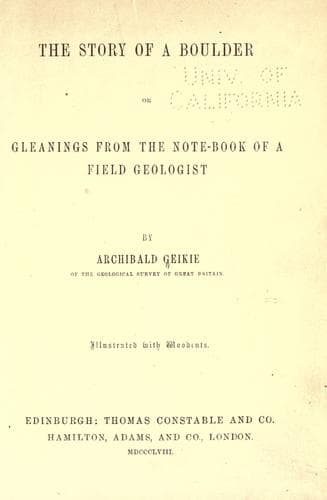
The Story of a Boulder; or, Gleanings from the Note-book of a Field GeologistGeikie, Archibald
Science
The Story of a Boulder; or, Gleanings from the Note-book of a Field Geologist
Geikie, Archibald
Geology; Petrology
new surface for the action of next winter. We can easily understand,
therefore, that in certain regions the combined effects of frost and
thaw may work in the course of ages changes of almost inconceivable
extent, and that the agency of ice must be not less varied and
important on the land than, in the case of the boulder clay, we found
it to be in the ocean.
Besides this action in winter, which goes on more or less in every
country wherever the temperature sinks sufficiently low to permit of
the freezing of water, ice effects many changes on the surfaces of
rocks when it takes the form of glaciers and icebergs. We have already
noted the operation of a glacier during its slow progress in crushing
down large fragments of stone, scratching and abrading the rocks over
which it passes, and eventually producing a vast quantity of mud, which
is carried down by streams to form new accumulations either in lakes
or seas. We have also marked the effects of the drifting iceberg in
materially modifying the contour of submarine hills, and depositing
over the ocean-bottom mud, gravel, and boulders. Nothing further,
therefore, need be done here than simply to keep these agencies in
view, as playing an important part in the disintegration of rocks.
Another highly interesting aqueous action is that of streams and
rivers, in scooping out for themselves channels through sometimes
the hardest and most solid rock. Such effects may be seen all over
the globe, in the old world and in the new, in the bed of the
tiniest rivulet, as well as in the course of the mightiest river.
And accordingly, in all the long list of geological agents, we find
none so well known and so often described alike by poets, historians,
and scientific writers, as well in ancient as in modern times. What
a delightful volume might be written about the geology of rivers! It
would, perhaps, begin with that "great river," the Euphrates, along
whose green banks lay the birthplace of the human race, tracing out the
features of its progress from the ravines and cataracts of Armenia,
with all their surrounding relics of ancient art, down into the plains
of Assyria, amid date-palms and Arab villages, onwards to the mounds
of Nineveh and Babylon, and thence to the waters of the Persian Gulf.
Well-nigh as remote, and perhaps still more interesting in its human
history, would be the story of the Nile. We should have to follow that
river from the mystic region of its birth,[53] marking the character
of the rocks through which winds its earlier channel, and the effects
upon them of the floods of untold centuries; it would be needful, too,
to note the influence of the waters on the lower grounds, from where
the stream flows over the cataracts of Syene, down through the alluvial
plains of Egypt; and lastly, the concluding and perhaps most onerous
part of our labour would be the investigation of the delta, marking its
origin and progress, its features in ancient times, as made known to us
Public-domain text, read in full here on John Shaqi.
Reviews
Reviews
No reviews yet
Be the first to share your thoughts on this work.
Elsewhere in the archive
Join the Discussion
Join the discussion
Sign in to leave a comment or review.
Sign InorCreate an account