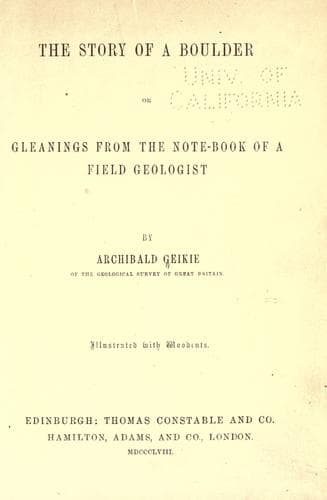
The Story of a Boulder; or, Gleanings from the Note-book of a Field GeologistGeikie, Archibald
Science
The Story of a Boulder; or, Gleanings from the Note-book of a Field Geologist
Geikie, Archibald
Geology; Petrology
comparison with known standards. The geological periods exemplify the
same rule. They may not be greater, perhaps not so great, as those
revealed by astronomy, yet their vastness impresses us more, because we
can trace out their history, and see how step by step they progressed.
Thus, that the interval between the boulder-clay and the coal-measurer
was immense, we learn from the records of many successive ages that
intervened, in the same way that one began to perceive the real breadth
of the firth, by resting his eye on the succession of intervening
herring-boats. In the former case, the mind has ever and anon a sure
footing on which to pause in gauging bygone eternity; in the latter,
the eye had likewise a succession of points on which to rest in
measuring distance. Or, to return to a former illustration: Boadicea
lived eighteen hundred years ago, but who does not feel that the last
nine hundred years look a great deal longer than the first? The one
set has few marked incidents to fix the thoughts; the other is replete
with those of the most momentous kind. In the one, we have M meagre
list of conquerors and kings, from Julius Cæsar down to Athelstan; in
the other, events crowd upon us from the waning of the Saxon power down
through the rising glory of our country to the present plenitude of
its power and greatness. The early centuries, like the cycles of the
astronomer, pass through our mind rather as one continuous period; the
later centuries, like the cycles of the geologist, arrest our thoughts
by a succession of minor periods, and hence the idea of duration is
more vividly suggested by the diversified events of the one series,
than by the comparatively unbroken continuity of the other.
Let us now open the volume and try to decipher the strange legends
which it contains. On removing some of the upper layers of the boulder,
I found, as I have said, well-preserved remains of several kinds of
plants. One of them was ribbed longitudinally, with transverse notches
every three or four inches, us though a number of slender threads
had been stretched along a rod, and tied tightly to it at regular
intervals. Another, sorely mutilated, was pitted all over somewhat
after the fashion in which the confectioner punctures his biscuits. A
third had a more regular pattern, being prettily fretted with small
lozenge-shaped prominences that wound spirally round the stalk. Other
plants seemed to be present, but in a very bad state of preservation.
They were all jumbled together and converted into a black coaly
substance, in which no structure could be discerned.
Public-domain text, read in full here on John Shaqi.
Reviews
Reviews
No reviews yet
Be the first to share your thoughts on this work.
Join the Discussion
Join the discussion
Sign in to leave a comment or review.
Sign InorCreate an account