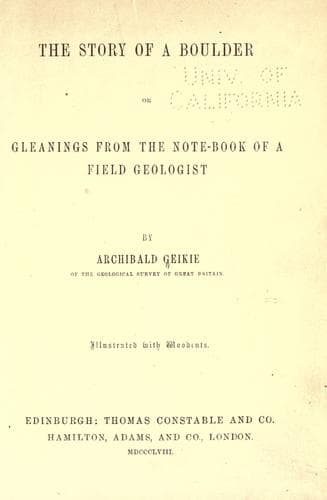
The Story of a Boulder; or, Gleanings from the Note-book of a Field GeologistGeikie, Archibald
Science
The Story of a Boulder; or, Gleanings from the Note-book of a Field Geologist
Geikie, Archibald
Geology; Petrology
These plants assuredly once grew green upon the land; but where now is
that land on which they flourished? Had it hills and valleys, rivers
and lakes, such as diversify our country? Was it tenanted by sentient
beings, and, if so, what were their forms? Did insects hum their way
through the air, and cattle browse on the plains, and fish gambol in
the rivers? Was the land shaded with forests, dark and rugged like
those of Norway, or fragrant as the orange-groves of Spain? What, in
fine, were its peculiar features, and how far did its scenery resemble
that of any country of the present day?
That old land has not entirely disappeared. Traces of it are found
pretty extensively in South Wales, in Staffordshire, around Newcastle,
and through central Scotland. Strange as it may seem, its forests
are still standing in many places. The fishes that disported in its
lakes, the insects that fluttered amid its woods, and the lizards that
crawled among its herbage, are still in part preserved to us. Nay,
more; we may sometimes see the sea-beaches of that ancient land pitted
with rain-drops, and roughened with ripple-marks, as freshly as if the
shower had fallen and the tide had flowed only yesterday. The peasants
along the Bay of Naples gathered grapes from the flanks of Vesuvius
for well-nigh seventeen centuries, before it was ascertained that they
daily walked over the site of buried cities, with temples, theatres,
and private houses still erect. It was many more centuries ere the
people of Great Britain discovered that not a few of their villages and
towns stood on the site of buried forests, and lakes, and seas. We have
now, however, become aware of the fact, and are making good use of it.
We dig into the earth and exhume these old forests to supply us with
light and fuel; we quarry into the ripple-marked shores which fringed
that old land, and build our houses with the hardened sand; we calcine
the ferruginous mud that gathered in its swampy hollows, and extract
therefrom our most faithful ally both in peace and war--metallic iron;
we burn the delicate corals and shells and lily-like zoophytes which
lived in the sea of that far-distant era, to enable us to smelt our
iron, to build our houses, and manure our fields; in short, every year
we are discovering some new and valuable material in the productions
of that period, or finding out some new use which can be made of the
substances already known. A more than ordinary interest, therefore,
attaches to the history of the land and sea which have furnished us
with so many aids to comfort as well as power; and we shall find, as we
go on, that that history is a very curious one.
Public-domain text, read in full here on John Shaqi.
Reviews
Reviews
No reviews yet
Be the first to share your thoughts on this work.
Join the Discussion
Join the discussion
Sign in to leave a comment or review.
Sign InorCreate an account