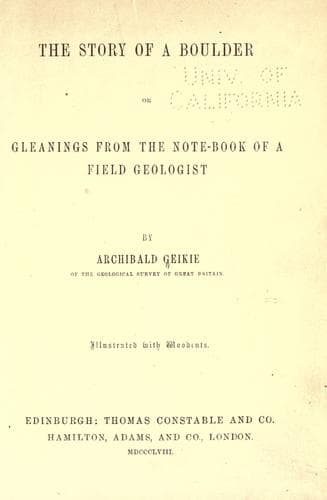
The Story of a Boulder; or, Gleanings from the Note-book of a Field GeologistGeikie, Archibald
Science
The Story of a Boulder; or, Gleanings from the Note-book of a Field Geologist
Geikie, Archibald
Geology; Petrology
but slightly inclined, it will be broader; the breadth of such a line
(which may be coloured to taste) always varying with the thickness
of the stratum and the angle which it makes with the horizon. In a
district where faults and curvatures along with trap-rocks abound, the
mapping becomes more complex, but the principle remains the same--a
curved stratum on the ground making a similarly curved band on the map,
and a fault or dislocation of a set of beds producing, in the same way,
a corresponding break in the lines traced. In short, a geological map
should be as far as possible a transcript of the surface rocks of a
country. The beginner should avoid, however, attempting too much; it
will be enough for him at first to have mastered the leading features
of the geology of his district; the details cannot be shown save on
a map of a large scale, and are better transferred to his note-book.
The use of such mapping is to enable us to gain a correct knowledge of
the geological structure of a country, and of the relation of rocks to
each other as regards age, origin, &c. Bacon tells us that "writing
makes an exact man;" we may say with equal truth that mapping makes
an exact geologist. It is sometimes easy enough to obtain a notion of
the general character of a district by taking a few rambles across it;
but we can never know it thoroughly until we have mapped it. And this
is done not as mere dry routine, or by a series of hard uninteresting
rules. In reading off the geological structure of a country, we
ascertain its history during many thousand ages long prior to that
of man. We become, as it were, interpreters of hieroglyphics, and
historians of long-perished dynasties.
Those who have had experience of field-geology, know how vain it is
to attempt to compress into a page or two the results of years, and
that a few vague general directions are about the utmost that can be
attempted. The practice of the science cannot be taught in books, far
less in prefaces, neither can it be learned from them. And so I once
more repeat the advice: Get away to the fields. Seek to decipher the
geological records for yourself, and look with your own eyes into the
long series of ages whose annals lie inscribed among the rocks. If you
can secure the co-operation of a few companions, so much the better.
Half-a-dozen hammers zealously at work in a richly fossiliferous
stratum will soon pile up a tolerable collection of its treasures. But
whether singly or in company, use your eyes and your hammer, and even
though in the end you should never become a geologist, you will in the
meantime gain health and vigour, and a clearness of observation, that
will stand you in good stead through life.
CONTENTS.
CHAPTER I.
PAGE
Scene near Colinton in midsummer--A grey travelled Boulder--Its
aspect and contents--Its story of the past,
1
CHAPTER II.
Public-domain text, read in full here on John Shaqi.
Reviews
Reviews
No reviews yet
Be the first to share your thoughts on this work.
Join the Discussion
Join the discussion
Sign in to leave a comment or review.
Sign InorCreate an account