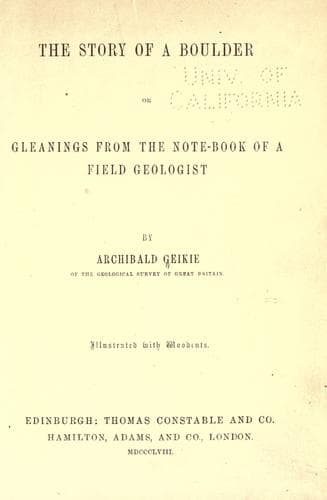
The Story of a Boulder; or, Gleanings from the Note-book of a Field GeologistGeikie, Archibald
Science
The Story of a Boulder; or, Gleanings from the Note-book of a Field Geologist
Geikie, Archibald
Geology; Petrology
when guilt with all its hideous train shall be for ever chased away
from the abodes of the redeemed.
[Footnote 32: In connexion with this subject I have been often struck
with a passage in St. Paul's Epistle to the Colossians, i. 10, "All
things were created by him [Christ] and for [εις--with a view to,
on account of] him." It is probable that these words, in their full
meaning, cannot be understood by us. Yet they seem to point to Christ
as at once the Creator, and himself the acme and design of creation;
and perhaps they may contain what hereafter shall prove the key to
the mystery of creation. On this impressive and difficult subject the
reader should refer to the closing chapter of Hugh Miller's _Footprints
of the Creator_. See also M'Cosh on _Typical Forms_, 2d edit. p. 531.]
Such thoughts as these sometimes arise in the mind of one who labours
much among organic remains. By no class of fossils are they more
vividly suggested than by those which we come next to examine--the
various tribes of molluscous animals. This results from the high
antiquity of these organisms, and the similarity of type which they
have manifested in all ages. In the very earliest geological periods
they exhibited the same symmetry of external form as now, the same
beauty of structure, and apparently the same delicacy of colour. Nay,
so closely did they resemble their existing congeners that we are
seldom at a loss as to their affinities, and can refer them to their
places in the scale of creation, and sometimes even to genera still
living.[33]
[Footnote 33: It must be admitted, however, that not a few of the
identifications already made are somewhat suspicious The natural
tendency is to perceive resemblances--a tendency which even the most
rigid science sometimes fails to control.]
The geological ages saw many strange types of creation. One era, in
especial, furnished reptiles which united in their structure the snout
of the porpoise, the head of the lizard, the teeth of the crocodile,
the paddles of the whale, and the backbone of the fish. Some displayed
the long pliant neck of the swan, and others careered through the
air on wings like those of the bat. But the molluscous tribes have
never exhibited such aberrant forms. The existing classes and orders
of the naturalist are still the same as those which nourished during
the successive geological periods. Hence their value as evidence of
physical changes in the ancient world. Hence, too, the conviction,
forced upon the mind of the observer, that the conditions for the
support of life never deviated much from those now in operation; that
in place of all the varied beauty of the world having arisen for the
use of man, it existed millions of years ere the breath of life had
been breathed into his nostrils; that in fine, man is but a new-comer,
a creation of yesterday.
Public-domain text, read in full here on John Shaqi.
Reviews
Reviews
No reviews yet
Be the first to share your thoughts on this work.
Elsewhere in the archive
Join the Discussion
Join the discussion
Sign in to leave a comment or review.
Sign InorCreate an account