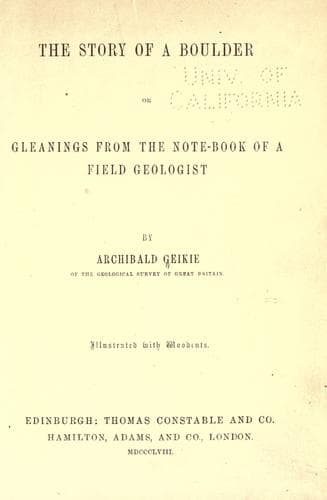
The Story of a Boulder; or, Gleanings from the Note-book of a Field GeologistGeikie, Archibald
Science
The Story of a Boulder; or, Gleanings from the Note-book of a Field Geologist
Geikie, Archibald
Geology; Petrology
the first dawn of life has ever been an onward one, as regards the
development not only of organic structure but of the social relations;
and if it be true that physical organization finds its archetype in
man, it is assuredly no less so that in him too we meet with the
highest manifestation of those instincts which, by linking individual
to individual, have ever marked out the vertebrate tribes of animals
from the more machine-like characteristics of the invertebrate.
We pass now to the vertebrate animals, and shall look for a little into
the general grade and organization of the fishes that characterized the
carboniferous rivers and seas.
A collection of the ichthyolites of the carboniferous rocks presents
almost every variety in the mode of preservation. The smaller species
are frequently found entire, and show their shining scales still
regularly imbricated as when the creatures were alive. The larger forms
seldom occur in other than a very fragmentary condition. The limestones
yield dark-brown or black, oblong, leech-like teeth, which are found
on examination to be those of an ancient family of sharks. The shales
are often sprinkled over with glittering scales and enamelled bones.
Some of the coals and ironstones yield in abundance long sculptured
spines, huge jaws bristling with sharp conical teeth, and detached
tusks, sometimes five or six inches long. In short, the naturalist who
would decipher the ichthyology of the Coal formation, finds before
him, in the rocks, not a suite of correctly arranged, and carefully
preserved skeletons, but a set of disjointed, unconnected bones; here
a tooth, there a scale, now a jaw, now a dermal plate, all mingled at
random. And yet, though the evidence lie in this fragmentary state, our
knowledge of these ancient fishes is far from being correspondingly
meagre. To such precision has the science of comparative anatomy
arrived, that a mere scale or tooth is often enough to indicate the
nature and functions of the individual to which it belonged, and to
establish the existence in former times of a particular class or order
of animals. Thus the smooth rounded teeth of the mountain limestone are
found to present both externally and internally a close resemblance to
the hinder flat teeth of the sole living cestraciont (_C. Philippi_);
and we hence learn that a family of sharks, now all but extinct,
abounded in the palæozoic seas. The occurrence of a set of dark,
rounded little objects, which by the unpractised eye would be apt to be
mistaken for pebbles, is in this way sufficient at once to augment our
knowledge of the various animals of the Carboniferous period, and to
establish an important fact in the history of creation.
Public-domain text, read in full here on John Shaqi.
Reviews
Reviews
No reviews yet
Be the first to share your thoughts on this work.
Elsewhere in the archive
Join the Discussion
Join the discussion
Sign in to leave a comment or review.
Sign InorCreate an account