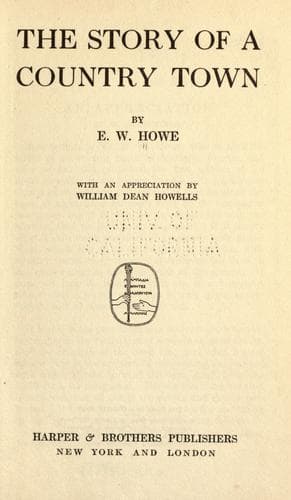
The Story of a Country TownHowe, E. W. (Edgar Watson)
General
The Story of a Country Town
Howe, E. W. (Edgar Watson)
Frontier and pioneer life -- Kansas -- Fiction
If two or three, or four or five, would not relent within a reasonable
time, the people gave up every other work, and gathered at the church in
great alarm, in response to the ringing of the bell, and there they
prayed and shouted the livelong day for the Lord to come down among
them. At these times Jo and I were usually left at home to work in the
field, and if we heard the people coming home in the evening shouting
and singing, we knew that the lost sheep had been recovered, and I often
feared they would form a ring around us in the field, and compel a full
surrender. A young woman who lived at our house to help my mother, the
daughter of a neighboring farmer, once engaged their attention for
nearly a week, but she gave up one hot afternoon, and came down the path
which led through the cornfields from the church, shouting and going on
like mad, followed by those that had been present when the Lord finally
came down, who were singing and proclaiming the event as loudly as they
could. This frightened me so much that I ran into the house, and hid
under the bed, supposing they would soon go away, and that then I could
come out; but they immediately began a prayer-meeting to give the new
convert opportunity to face a frowning world by relating her experience,
and thus they kept me in my uncomfortable position until I thought I
must smother from the heat.
My father received little aid in the conduct of these meetings except
from a very good farmer, but very bad exhorter, named Theodore Meek,
whose name had been gradually shortened by neighborhood familiarity
until he was known as The. Meek; and for a long time I thought he was
meant when reference was made to “The Meek and lowly,” supposing that
Lowly was an equally good man living in some of the adjoining
settlements. This remarkable man laughed his religion rather than
preached, or prayed, or shouted, or sang it. His singing would be
regarded at this day as a very expert rendering of a laughing song, but
to us it was an impressive performance, as were his praying and
occasional preaching, though I wonder we were not amused. The. Meek was,
after my father, the next best man in Fairview; the next largest farmer,
and the next in religion and thrift. In moving to the country I think
his wagons were next to ours, which headed the procession. He sat
nearest the pulpit at the meetings, was the second to arrive--my father
coming first--and always took up the collections. If there was a
funeral, he stood next my father, who conducted the services; at the
school-meetings he was the second to speak; and if a widow needed her
corn gathered, or her winter’s wood chopped, my father suggested it, and
The. Meek immediately said it should have been attended to before. He
also lived nearer our house than any of the others, and was oftener
there; and his house was built so much like ours that only experts knew
it was cheaper, and not quite so large. His family, which consisted of a
Public-domain text, read in full here on John Shaqi.
Reviews
Reviews
No reviews yet
Be the first to share your thoughts on this work.
Join the Discussion
Join the discussion
Sign in to leave a comment or review.
Sign InorCreate an account