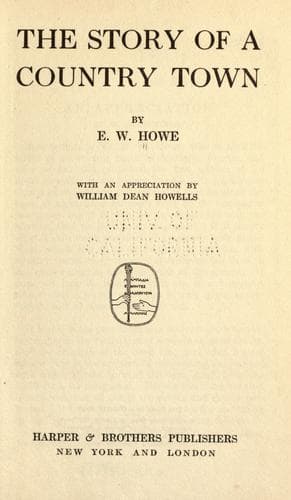
The Story of a Country TownHowe, E. W. (Edgar Watson)
General
The Story of a Country Town
Howe, E. W. (Edgar Watson)
Frontier and pioneer life -- Kansas -- Fiction
fat wife by a second marriage, and so many children that I never could
remember all their names--there was always a new baby whenever its
immediate predecessor was old enough to name--were laughers like him,
and to a stranger it would have seemed that they found jokes in the
Bible, for they were always reading the Bible, and always laughing.
Another assistant was Mrs. Tremaine, the miller’s widowed sister, who
had lived in the country before we came, a wax-faced woman who
apparently had no other duty to attend to than religion; for although
she lived a considerable distance from Fairview church, she was always
at the meetings, and I have thought of her as being constantly occupied
in coming from or going to church, finding it time to start back again
as soon as she reached home. The only assistance she afforded was to
pray whenever called upon in a voice so low that there was always doubt
when she had finished; but this made little difference, as it gave the
others opportunity to be heard in short exclamations concerning the
kindness of the Lord if sinners would really renounce the world and make
a full confession. Her speeches in the experience meetings were of the
same order, and when she sat down the congregation invariably began a
song descriptive of a noble woman always battling for the right, and
sure to conquer in the end; from which grew an impression that she was a
very sainted person, and that the sins of her brother, the miller, were
much on her mind. It is certain that he thought little of them himself,
never attending the services, or sending his regrets.
It was usually a part of my duty on Sunday to take one of the wagons, Jo
taking the other, and to drive about collecting infirm and unfortunate
people who would otherwise be unable to attend church; for my father
believed in salvation for all who were willing to accept it, though they
were poor, and unable to walk, or hear, or see, or understand; and he
was kinder to the unfortunate people than to any of the others, favoring
them out of his strength and abundance in a hundred ways.
There was always a suspicion in my mind, which may have been an unjust
one, that they shouted and went on in response to his preaching because
he was their friend, and wanted them to do so. In any event, he could
throw them into the greatest excitement, and cause them to exhibit
themselves in the most remarkable way, whenever he saw fit, so that they
got on very well together.
Public-domain text, read in full here on John Shaqi.
Reviews
Reviews
No reviews yet
Be the first to share your thoughts on this work.
Join the Discussion
Join the discussion
Sign in to leave a comment or review.
Sign InorCreate an account