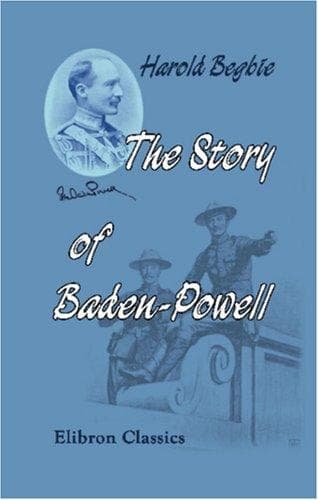
The Story of Baden-Powell: 'The Wolf That Never Sleeps'Begbie, Harold
History
The Story of Baden-Powell: 'The Wolf That Never Sleeps'
Begbie, Harold
Baden-Powell of Gilwell, Robert Stephenson Smyth Baden-Powell, Baron, 1857-1941
But it was not only at football that Baden-Powell spent his time in
the playground, although it was only in football that he shone. Into
every game he threw himself with zest and earnestness, playing hard
for his side, and finding himself always regarded by his opponents as
an enemy to be treated with respect. That he continued to play
cricket, racquets, and fives, although not a great success, is
characteristic of his devotion to sports, and his habit of doing what
is the right thing to do. Then he was a faithful and lively
contributor to the school magazine, added his lusty young voice to the
chapel choir, and was for ever seeking out excuses for getting up
theatricals. Of one of his performances at the end of the Long Quarter
in 1872 it is interesting to note that the _Era_ of that time remarked
that it was "full of vivacity and mischief." He was always a great
success as an old woman, and we shall see that in later days he played
a woman's part with huge success in far Afghanistan. At one of these
school entertainments big brother Warington was present, and he
laughingly recalls how the vast audience of shiny-faced boys broke
into a great roar of delight directly B.-P. appeared in the
wings--before he had uttered a word or made a grimace. Dr. Haig-Brown
and the other masters who remember B.-P. like to recall scenes of
this kind, and it is no disparagement of Ste's other sterling
qualities that they seem to have been more impressed by his excellent
fooling than by any other of his good qualities. It is the greater
tribute to his genius for acting.
[Illustration: Rev. William Haig-Brown, LL.D.
Lombardi & Co., Photographers, 27, Sloane Street, S.W.]
So long as the world lasts, I suppose, the intelligent boy who works
hard at school will play the clown's part in popular fiction. Tom
Sawyer is the kind of youth we like to see given the chief part in a
novel, while George Washington, we are all agreed, is fit target for
our lofty scorn. But how few of the people we love to read about in
the airy realm of fiction, or the still airier realm of history,
really possess our hearts? Think over the heroes in novels who would
be drawn in with both hands to the fireside did they step out from
between covers and present themselves at our front door in flesh as
solid as the oak itself. And the good boy in fiction is anathema.
Shakespeare himself believed that
Love goes towards love, as schoolboys from their books;
and the man is regarded almost as un-English who would have the world
believe that there are British boys for whom the acquisition of
knowledge has almost the same attraction as for their heroes in
fiction has the acquisition of somebody's apples, or the tormenting of
helpless animals.
Public-domain text, read in full here on John Shaqi.
Reviews
Reviews
No reviews yet
Be the first to share your thoughts on this work.
Join the Discussion
Join the discussion
Sign in to leave a comment or review.
Sign InorCreate an account