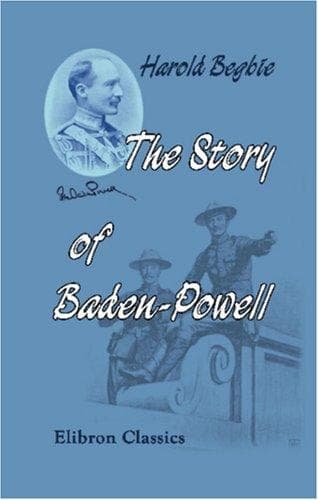
The Story of Baden-Powell: 'The Wolf That Never Sleeps'Begbie, Harold
History
The Story of Baden-Powell: 'The Wolf That Never Sleeps'
Begbie, Harold
Baden-Powell of Gilwell, Robert Stephenson Smyth Baden-Powell, Baron, 1857-1941
The fault is not with the world but with the silly writers of
goody-goody stories, who have so emasculated and effeminated the boy
who works hard and holds his head high that it is now well-nigh
impossible to hear of such an one in real life without instantly
setting him down as an intolerable prig. These writers have committed
the greatest crime against their creations that authors can
commit--they have made them non-human. If the stories about George
Washington had narrated how on one occasion he laughed uproariously,
or how he once ate too many mince-pies, he might have escaped the
lamentable and unjust reputation which seems likely to be his fate for
another aeon or two. That boys can be good and human everybody knows,
and the man who loves Tom Sawyer and sneers at Eric would be the first
to flog and abuse his son if he bore a closer resemblance to the
former than to the latter.
Baden-Powell as a boy was delightful. A grin always hovered about his
face, and the Spirit of Fun herself looked out of his sharp, brown
eyes. He was for ever making "the other chaps" roar; keeping a
football field on the giggle; sending a concert-audience into fits.
But he was just the sort of schoolboy of whom there would be no
incidents to record. Men who knew him and lived with him in those days
remember him, perhaps, more distinctly than any other boy of their
time, and at the merest mention of his name their eyes twinkle with
delight. "Oh, old Bathing Towel. George! what a funny beggar he was.
Remember him? I should think I did. Stories about him? Well, I don't
remember any just now, but dear old Bathing Towel----!" and off they
go into another roar of laughter. All they can tell you is how he used
to act and recite, and play all manner of musical instruments, or, if
you drag them away from the stage, how he used to rend the air with
his terrible war-whoop at the critical moment in a football match.
But although this is how it strikes a contemporary, Baden-Powell was
in deadly earnest when it was a matter of books and ink-pots. He might
be the funny man of the school, but he was also one of the most
brilliant. He gave his masters the impression of a boy who really
delighted in getting on; who was really keen about mastering a
difficult subject. His vivacity and freshness, his energy and vigour,
helped him to take pleasure in work which to another boy, less
physically blessed, would have been an irksome toil; but though his
body may have projected him some distance upon his way, it was his
soul that really carried him triumphantly through. The spirit of
Baden-Powell in those days was what it is now--supremely intent upon
beating down obstacles in his path, and resolute to do well whatever
the moment's duty might be. So the boy who was setting a football
field on the roar at one moment, at the next would be sitting with
fixed eyes and knit brows, "hashing" at Latin verses, as serious as a
leader-writer hurling his bolts at the European Powers.
Public-domain text, read in full here on John Shaqi.
Reviews
Reviews
No reviews yet
Be the first to share your thoughts on this work.
Join the Discussion
Join the discussion
Sign in to leave a comment or review.
Sign InorCreate an account