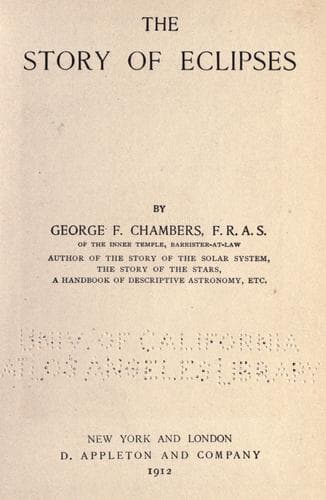
The Story of EclipsesChambers, George F. (George Frederick)
History
The Story of Eclipses
Chambers, George F. (George Frederick)
Eclipses
On April 16, 1893, there happened a total eclipse of the Sun, which was
successfully watched by a large number of skilled observers throughout
its entire length. Indeed it is believed that only one party was
unsuccessful. The line of totality started on the coast of Chili, passed
over the highlands of that country, across the borders of Argentina and
Paraguay, and over the vast plains and forests of Central Brazil,
emerging at about noon of local time at a short distance to the N.-W. of
Ceara on the North Atlantic seaboard. Crossing the Atlantic nearly at
its narrowest part, it struck the coast of Africa N. of the river
Gambia, and finally disappeared somewhere in the Sahara. The South
American observations were the most extensive and successful, the latter
fact being due to the circumstance that the sky at many of the principal
stations was pre-eminently favourable, owing to the clearness and
dryness of the atmosphere.
On Sept. 29, 1894, there was a total eclipse of the Sun, but as its
duration was brief and the zone of totality lay chiefly over the Indian
Ocean, practically nothing came of it.
Things seemed, however, much more promising for the total eclipse of
Aug. 9, 1896, and a very large number of observers went out to the North
of Norway hoping to catch the shadow at its European end, whilst a
yacht party went to Nova Zembla in the Arctic Ocean, and a few observers
travelled as far as Japan. So far as the very large number of would-be
observers who went from England to Norway were concerned, the eclipse
was a profound disappointment, for owing to bad weather practically
nothing was seen in Norway except on the West coast near Bodö, where the
weather was beautifully fine, but where no adequate preparations had
been made, because nobody believed that the coast would be free from
fog. Exceptionally fine weather prevailed at Nova Zembla, and the small
but select party who were kindly taken there by the late Sir G. B.
Powell, M.P., in his yacht, were very fortunate, and an excellent series
of photographs was secured. One important result obtained at Nova Zembla
was a full confirmation by Mr. Shackleton of Prof. Young’s discovery in
1870 of the “Reversing Layer,” a discovery which was long and vehemently
disputed by Sir Norman Lockyer. Fairly successful observations were made
of this eclipse in Siberia and Japan.
Public-domain text, read in full here on John Shaqi.
Reviews
Reviews
No reviews yet
Be the first to share your thoughts on this work.
Elsewhere in the archive
Join the Discussion
Join the discussion
Sign in to leave a comment or review.
Sign InorCreate an account