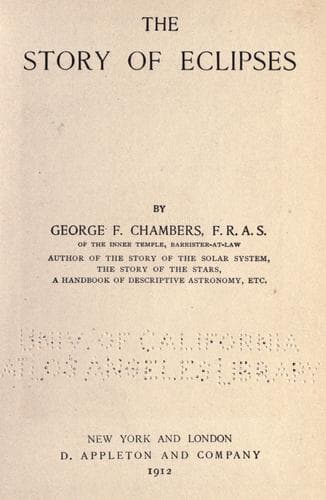
The Story of EclipsesChambers, George F. (George Frederick)
History
The Story of Eclipses
Chambers, George F. (George Frederick)
Eclipses
Though the unusual opportunities which, so far as the Sun and the Moon
were concerned, were afforded by the eclipse of 1886 were lost,
astronomers looked out hopefully for August 19, 1887, when another
eclipse was due to happen which, weather permitting, would be observable
over a very long stretch of land, from Berlin through Russia and Siberia
to Japan. Unusually extensive preparations were made in Russia at one
end and in Japan at the other, but clouds prevailed very generally, and
the pictures of the Corona which were obtained fell far short in number
and quality from what had been hoped for, having regard to the number
and importance of the stations chosen, and of the astronomers who made
their preparations thereat. An enthusiastic Russian, in the hopes of
emancipating himself from the risks of terrestrial weather at the
Earth’s surface, went up in a balloon to an elevation of more than two
miles. His enthusiasm was so far rewarded that he had a very clear view
of a magnificent Corona; but as, owing to some mischance, the balloon
rose, conveying only the astronomer and leaving behind his assistant who
was to have managed the balloon, all his time was engrossed by the
management of the balloon, and he could do very little in the way of
purely astronomical work.
The year 1889 afforded two total eclipses of the Sun for which the usual
preparations were made. The first occurred on New Year’s Day, and the
path of the shadow crossed the North American Continent from California
to Manitoba. The weather was nearly everywhere very favourable, and an
enormous number of observers and instruments were assembled along the
central line. The consequence was that a very large number of
photographs were obtained. It may be said generally of this eclipse,
that as it coincided with a Sun-spot minimum, it left us in a position
to learn very distinctly what are the characteristic features of a solar
Corona at a period which is one of rest and repose on the Sun, at least,
so far as regards visible Sun-spots.
The second eclipse of 1889 occurred on December 22, and should have been
visible off the northern coast of South America and on the West Coast of
Africa. Attempts were made to utilise the South American chances by
English and American parties, whilst a small expedition comprising
astronomers of both nations went to Cape Ledo in West Africa. The
African efforts failed entirely owing to clouds, but the South American
parties at Cayenne were successful. One very deplorable result, however,
arising out of the expedition to Cayenne was the illness and subsequent
death of the Rev. S. J. Perry, S.J., who was struck down by malaria and
died at sea on the return journey. None who knew Mr. Perry personally
could fail to realise what a loss he was both to astronomy generally and
to his own circle of friends particularly.
Public-domain text, read in full here on John Shaqi.
Reviews
Reviews
No reviews yet
Be the first to share your thoughts on this work.
Elsewhere in the archive
Join the Discussion
Join the discussion
Sign in to leave a comment or review.
Sign InorCreate an account