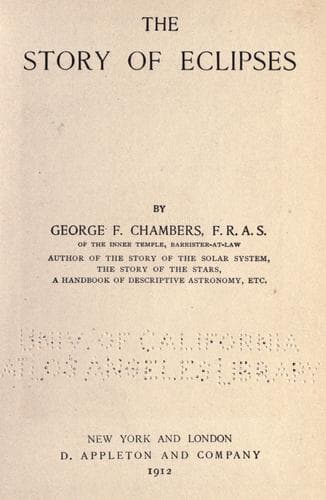
The Story of EclipsesChambers, George F. (George Frederick)
History
The Story of Eclipses
Chambers, George F. (George Frederick)
Eclipses
This, however, is a digression. The circumstances of this eclipse as
regards its identification having been carefully examined by Mr. R. W.
Rothman,[19] in 1839 were further reviewed by Professor S. M. Russell
in a paper published in the proceedings of the Pekin Oriental
Society.[20] The substance of the case is that in the reign of
Chung-K’ang, the fourth Emperor of the Hsia Dynasty, there occurred an
eclipse of the Sun, which is interesting not only for its antiquity, but
also for the dread fate of the two Astronomers Royal of the period, who
were taken by surprise at its occurrence, and were unprepared to perform
the customary rites. These rites were the shooting of arrows and the
beating of drums, gongs, etc., with the object of delivering the Sun
from the monster which threatened to devour it. The two astronomers by
virtue of their office should have superintended these rites. They were,
however, drunk and incapable of performing their duties, so that great
turmoil ensued, and it was considered that the land was exposed to the
anger of the gods. By way of appeasing the gods, and of suitably
punishing the two State officials for their neglect and personal
misconduct, they were forthwith put to death, a punishment which may be
said to have been somewhat excessive, in view of the fact that the
eclipse was not a total but only a partial one. An anonymous verse
runs:—
Here lie the bodies of Ho and Hi,
Whose fate though sad was visible—
Being hanged because they could not spy
Th’ eclipse which was invisible.
It appears beyond all reasonable doubt that the eclipse in question
occurred on October 22, 2136 B.C. The preliminary difficulties to be
got over in arriving at the date arose from the fact that there was an
uncertainty of 108 years in the date when the Emperor Chung-K’ang
ascended the throne; and within these limits of time there were 14
possible years in which an eclipse of the Sun in Fang could have
occurred. Then the number was further limited by the necessity of
finding an eclipse which could have been seen at the place which was the
Emperor’s capital. The site of this, again, was a matter of some
uncertainty. However, step by step, by a judicious process of
exhaustion, the year 2136 B.C. was arrived at as the alternative to the
previously received date of 2128 B.C. Considering that we are dealing
with a matter which happened full 4000 years ago, it may fairly be said
that this discrepancy is not perhaps much to be wondered at, seeing what
disputes often happen nowadays as to the precise date of events which
may have occurred but a few years or even a few months before the
controversy springs up.
Public-domain text, read in full here on John Shaqi.
Reviews
Reviews
No reviews yet
Be the first to share your thoughts on this work.
Join the Discussion
Join the discussion
Sign in to leave a comment or review.
Sign InorCreate an account