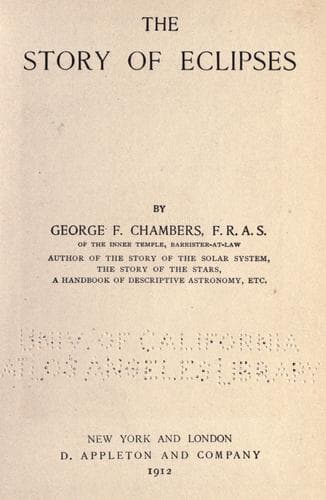
The Story of EclipsesChambers, George F. (George Frederick)
History
The Story of Eclipses
Chambers, George F. (George Frederick)
Eclipses
Professor Russell says that:—“Some admirers of the Chinese cite this
eclipse as a proof of the early proficiency attained by the Chinese in
astronomical calculations. I find no ground for that belief in the text.
Indeed, for many centuries later, the Chinese were unable to predict the
position of the Sun accurately among the stars. They relied wholly on
observation to settle their calendar, year by year, and seem to have
drawn no conclusions or deductions from their observations. Their
calendar was continually falling into confusion. Even at the beginning
of this dynasty, when the Jesuits came to China, the Chinese
astronomers were unable to calculate accurately the length of the shadow
of the Sun at the equinoxes and solstices. It seems to me therefore very
improbable that they could have been able to calculate and predict
eclipses.”
I am not at all sure that this is quite a fair presentation of the case.
I do not remember ever to have seen the power to predict eclipses
ascribed to the Chinese, but it is a simple matter of fact that we owe
to them during many centuries unique records of a vast number of
celestial phenomena. Their observations of comets may be singled out as
having been of inestimable value to various 19th-century computers,
especially E. Biot and J. R. Hind.
The second recorded eclipse of the Sun would seem to be also due to the
Chinese. Confucius relates that during the reign of the Emperor Yew-Wang
an eclipse took place. This Emperor reigned between 781 B.C. and 771
B.C., and it has been generally thought that the eclipse of 775 B.C. is
the one referred to, but Johnson doubts this on the ground that this
eclipse was chiefly visible in the circumpolar regions, and if seen at
all in China must have been of very small dimensions. He leans to the
eclipse of June 4, 780 B.C. as the only large one which happened within
the limits of time stated above.
An ancient Chinese historical work, known as the _Chun-Tsew_, written by
Confucius, makes mention of a large number of solar eclipses which
occurred before the Christian Era. This work came under the notice of M.
Gaubil, one of the French Jesuit missionaries who laboured in China
some century and a half ago, and he first gave an account of it in his
_Traité de la Chronologie Chinoise_, published at Paris in 1770.[21]
The _Chun-Tsew_ is said to be the only work really written by
Kung-Foo-Tze, commonly known as Confucius, the other treatises
attributed to him having been compiled by disciples of his either during
his life-time or after his decease. The German chronologist, Ideler, was
acquainted with this work, and in a paper of his own, presented to the
Berlin Academy, remarked:—“What gives great interest to this work is the
account of 36 solar eclipses observed in China, the first of which was
on Feb. 22, 720 B.C., and the last on July 22, 495 B.C.”
Public-domain text, read in full here on John Shaqi.
Reviews
Reviews
No reviews yet
Be the first to share your thoughts on this work.
Join the Discussion
Join the discussion
Sign in to leave a comment or review.
Sign InorCreate an account