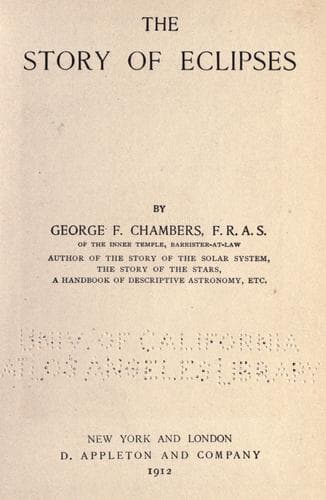
The Story of EclipsesChambers, George F. (George Frederick)
History
The Story of Eclipses
Chambers, George F. (George Frederick)
Eclipses
In spite of the unattractive, not to say forbidding, character of the
place to which they would have to go, parties of astronomers went out
from England, France, Austria, and Italy, and although rain fell on the
morning of the day the sky became quite clear by the time of totality
and the observations were completely successful. One of the pictures of
the Corona obtained by Trouvelot, an observer of French descent, but
belonging to the American party, has been often reproduced in books and
exhibited the Corona in a striking form. How few were the attractions of
Caroline Island as an eclipse station may be judged from the fact that
the inhabitants consisted of only four native men, one woman, and two
children who lived in three houses and two sheds.
On September 8, 1885, there occurred a total eclipse, which was seen as
such in New Zealand, but the observations were few, and with one
exception, unimportant and uninteresting. A certain Mr. Graydon,
however, made a sketch which showed at one point a complete break in the
Corona so that from the very edge of the Moon outwards into space, there
was a long and narrow black space showing nothing but a vacuity. If this
was really the condition of things, such a break in the Corona is
apparently quite unprecedented.
In 1886, on August 29, there occurred a total eclipse, visible in the
West Indies, which yielded various important results. It was unfortunate
that for the greater part of its length, the zone of totality covered
ocean and not land, the only land being the Island of Grenada and some
adjacent parts of South America. The resulting restriction as regards
choice of observing stations was the more to be regretted because the
duration of the totality was so unusually long, and therefore
favourable, being more than 6½ minutes in the middle of the Atlantic
Ocean. Parties of English, American, and Italian astronomers assembled,
however, at Grenada, and though the weather was not the best possible,
some interesting photographs were obtained which exhibited an unusual
development of hydrogen protuberances. The central line in this eclipse
not only stretched right across the Atlantic, but entered Africa on the
West Coast where a missionary saw the eclipse as a mere spectator, and
afterwards expressed his regret that no astronomers were within reach
with instruments to record the remarkable Corona which was displayed to
his gaze.
Public-domain text, read in full here on John Shaqi.
Reviews
Reviews
No reviews yet
Be the first to share your thoughts on this work.
Elsewhere in the archive
Join the Discussion
Join the discussion
Sign in to leave a comment or review.
Sign InorCreate an account