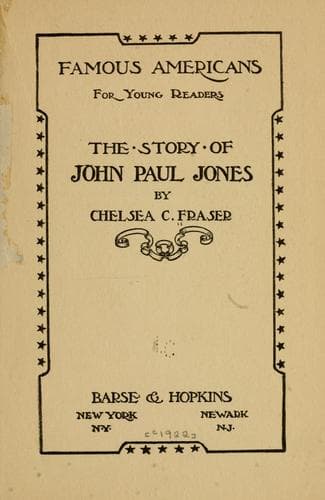
The Story of John Paul JonesFraser, Chelsea Curtis
History
The Story of John Paul Jones
Fraser, Chelsea Curtis
Jones, John Paul, 1747-1792
In this appeal to Congress there was good common-sense. Paul Jones was
not actuated by a love of gain; he was in the struggle because he
thought it a righteous cause. Yet he knew that while he had the profits
of his plantation for the past two or three seasons--some 4000
pounds--to fall back upon when his Government allowances should fail to
meet expenses, the average Colonist did not. The wives and children of
the latter must be fed and clothed while he was away fighting. Unless
he could be promised ample revenue from prizes, Paul Jones knew that
Jack would fight half-heartedly and in the dumps, even though he loved
his country in every fiber of his being. His pitifully inadequate
Government allowance of eight dollars a month was surely no attraction.
On November 15, 1776, Congress improved this situation somewhat, but did
not meet Paul Jones's wishes in the matter, by resolving "that a bounty
of twenty dollars be paid to the commanders, officers, and men, of such
Continental ships or vessels of war as shall make a prize of any British
ships or vessels of war, for every cannon on board such a prize at the
time of such capture; and eight dollars per head for every man then on
board and belonging to such prize."
In addition to this General Washington approved the following
distribution of the prize: "That the captain or commander should receive
six shares; the first-lieutenant, five, the second-lieutenant and the
surgeon, four; the master, three; steward, two; mate, gunner,
gunner's-mate, boatswain, and sergeant, one and one-half shares; the
private, one share." Nothing was said about the poor cook. Undoubtedly
he ranked with the ordinary seaman when the time of distribution came.
To all intents and purposes an American, the truth remains that Paul
Jones was a Scotchman. His enthusiastic soul was wholly for the cause of
liberty in his new country, but the men who envied him and wanted the
offices for which his high capabilities fitted him so signally never let
him and others forget that he was an alien. This was, of course, quite
absurd; for what were they themselves? What had they been until a few
months ago? The fact is, Paul Jones had served under three masters,
until he was a far more competent officer than many of those in the
established navies of Europe, where influence and patronage often made
officers of men of long lineage and short experience.
Thus in the _Journal of Congress_, dated December 22, 1775, the name of
Paul Jones heads the list of first-lieutenants, instead of the list of
captains as it should. His friend Joseph Hewes, who championed the
candidates from the southern colonies, had done his best to make the
young planter a captain, but had failed at the antagonism of John Adams,
who represented the candidates from the northern colonies, which
demanded full control of naval affairs.
Public-domain text, read in full here on John Shaqi.
Reviews
Reviews
No reviews yet
Be the first to share your thoughts on this work.
Join the Discussion
Join the discussion
Sign in to leave a comment or review.
Sign InorCreate an account