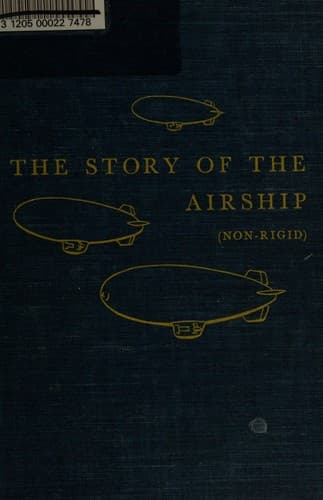
The Story of the Airship (Non-rigid): A Study of One of America's Lesser Known Defense WeaponsAllen, Hugh
History
The Story of the Airship (Non-rigid): A Study of One of America's Lesser Known Defense Weapons
Allen, Hugh
Military airships -- United States
[Illustration: Blimps too may use masts aboard surface ships as
anchorage point on long cruises, as the U.S.S. Los Angeles
successfully demonstrated when moored to the U.S.S. Patoka. (U. S.
Navy photo)]
[Illustration: The Army’s TC-7 demonstrates the first airplane
pick-up at Dayton. Army pilots found that at flying speed the plane
weighed nothing, was sustained by dynamic forces. (U. S. Army
photo)]
Flight was here, though it would be a long time becoming practical. Dr.
Charles and many others contributed, even at that early day. Knowing
that hydrogen expanded as the air pressure grew less, at higher
altitudes, Charles devised a valve at the top of the balloon, so that
the surplus gas could be released, not burst the balloon. He devised a
net from which the basket could be suspended, distributing its load over
the entire bag.
The drag rope was evolved, an ingenious device to stabilize the
balloon’s flight in unstable air. If the balloon tended to rise it would
have to carry the entire weight of the rope. If it grew sluggish and
drifted low, it had less weight to carry, as much of the rope now lay on
the ground. These ballooning principles, early found, are still in use.
But the “dirigible” balloon, or airship must wait for light weight,
dependable motors, despite the hundreds of ingenious experiments made by
men over a full century.
Since this is an airship story, we should first make clear the
difference between the airship and the airplane.
The French hit on an apt phrase to distinguish them, dividing aircraft
into those which are lighter than the air, such as airships, and those
which are heavier than the air, like airplanes.
Airships are literally lighter than air. So are all free balloons, used
for training and racing, and all anchored balloons, such as the
observation balloon widely used in the last war and the barrage balloons
of the present war.
The airship goes up and stays up because the buoyancy given by its
lifting gas makes it actually lighter than the air it displaces, and
even with the load of motors, fuel, equipment and passengers, must still
use ballast to hold it in equilibrium.
The airplane, on the other hand, is heavier than the air. Even the
lightest plane can stay up only if it is moving fast enough to get a
lifting effect from the movement of air along the wings, similar to that
which makes a kite stay up. A kite may be flown in calm weather only if
the one who holds the cord keeps running. On a windy day, the kite may
be anchored on the ground, and the movement of the wind alone will have
sufficient lifting effect. So powerful are these air forces that a plane
weighing 20 tons may climb to an altitude of 10,000 feet if its speed is
great enough, and its area of wing surface broad enough to produce this
kiting effect.
Public-domain text, read in full here on John Shaqi.
Reviews
Reviews
No reviews yet
Be the first to share your thoughts on this work.
Join the Discussion
Join the discussion
Sign in to leave a comment or review.
Sign InorCreate an account