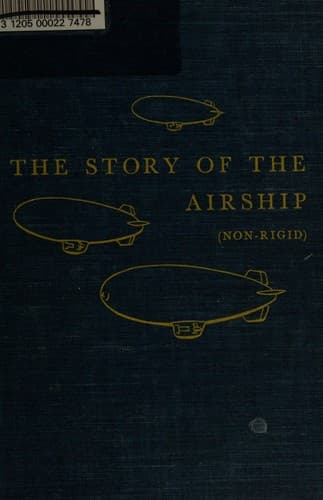
The Story of the Airship (Non-rigid): A Study of One of America's Lesser Known Defense WeaponsAllen, Hugh
History
The Story of the Airship (Non-rigid): A Study of One of America's Lesser Known Defense Weapons
Allen, Hugh
Military airships -- United States
But an airplane can remain aloft only as long as it is moving faster
than a certain minimum speed. Cut the motors, or even throttle down
below this stalling speed, and the plane will start earthward.
The airship needs its motors only to propel it forward. It can cut its
speed, even stop its engines, and nothing happens. It retains its
buoyancy, continues to float. The airplane’s lift is dynamic, that of
the airship is static.
The airship has some dynamic lift, also, because its horizontal fins or
rudders, and the body of the airship have some kiting effect in flight.
The blimp pilot, starting on a long trip, will fill up his tanks with
all the fuel the ship can lift statically, then take on another 2,000
pounds, taxi across the airport till he gets flying speed and so get
under way with many more miles added to his cruising speed.
This dynamic lift however, while useful in certain operations is still
incidental. Primarily the airship gets its lift from the fact that the
gas in the envelope is much lighter than the air.
Hydrogen is only one-fifteenth the weight of air, helium, the
non-inflammable American gas, is a little heavier, about one-seventh.
The practical lift is 68 pounds to the thousand cubic feet of hydrogen,
63 pounds in the case of helium.
Lighter-than-air ships are of three classes, rigid, semi-rigid and
non-rigid. The rigid airship has a complete metal skeleton, which gives
the ship strength and shape. Into the metal frame of the rigid airship
are built quarters, shops, communication ways, even engine rooms in the
case of the Akron and Macon, with only the control car, fins, and
propellers projecting outside the symmetrical hull. The lifting gas is
carried in a dozen or more separate gas cells, nested within the bays of
the ship.
The non-rigid airship has no such internal support. The bag keeps its
taut shape only from the gas and air pressure maintained within. Release
the gas and the bag becomes merely a flabby mass of fabric on the hangar
floor. Ship crews do not live in the balloon section, but in the control
car below.
The British, apt at nicknames, differentiated between the two types of
airships by calling them “rigid” and “limp” types, and since an early
“Type B” was widely used in the first World War, quickly contracted “B,
limp” into the handier word “Blimp.”
The third type, semi-rigid, has a metal keel extending the length of the
ship, to which control surfaces and the car are attached, and with a
metal cone to stiffen the bow section.
The rigid ship is of German origin. Developed by Count Zeppelin, retired
army officer, and largely used by that nation during the war of 1914-18,
it was taken up after the war started, by the British and Americans, and
to a small extent later by France and Italy.
Non-rigid ships were widely used by the British and French, to a less
extent by Italy and United States.
Public-domain text, read in full here on John Shaqi.
Reviews
Reviews
No reviews yet
Be the first to share your thoughts on this work.
Join the Discussion
Join the discussion
Sign in to leave a comment or review.
Sign InorCreate an account