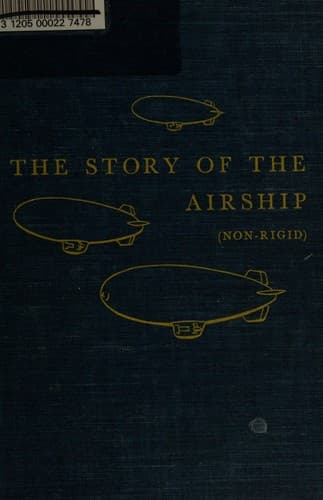
The Story of the Airship (Non-rigid): A Study of One of America's Lesser Known Defense Weapons — John Shaqi
The Story of the Airship (Non-rigid): A Study of One of America's Lesser Known Defense WeaponsAllen, Hugh
History
The Story of the Airship (Non-rigid): A Study of One of America's Lesser Known Defense Weapons
Allen, Hugh
Military airships -- United States
This grew out of the fact that the Allies planned to order the Zeppelin
works at Friedrichshafen torn down but had held up the order long enough
for it to turn out one more ship. This last ship would be given to
United States in lieu of the Zeppelin this country would have received
from Germany, if the airship crews, like those of the surface fleet, had
not scuttled their craft after the Armistice, to keep them from falling
into enemy hands. The Allies stipulated that the Los Angeles should
carry no armament. It took a specific waiver from them for the ship to
take part several years later in fleet maneuvers.
Other airship activities in this country were at a minimum. The blimps,
little heard of in this country during War I, remained in the
background. A joint board of the two services gave the Navy
responsibility for developing rigid airships, the Army to take
non-rigids and semi-rigids. The Navy maintained a few post-war blimps
for training, had little funds except for maintenance.
The Army, having Wright Field to do its engineering and experimental
work, fared somewhat better, carried on a training and something of a
development program. It built bases at Scott Field, Ill., and Langley
Field, Va., ordered one or two non-rigid ships a year, purchased a
semi-rigid ship from Italy, ordered another, the RS-1, from Goodyear,
operated it successfully.
The Army’s non-rigids, however, were overshadowed by the Navy’s rigids
and even more by its own airplanes, with the result finally that the
Chief of the Air Corps, Major General O. O. Westover, a believer in
lighter-than-air, an airship as well as airplane pilot, and a former
winner of the James Gordon Bennett cup in international balloon racing,
told Congress bluntly that there was no point in dragging along, that
unless funds were appropriated for a real airship program the Army might
as well close up shop. And this step Congress, in the end, took, and the
Army blimps and equipment were transferred to the Navy, and the
experimental program started by the one service was carried on by the
other.
The rigid ships were in more favorable position because they seemed to
have commercial possibilities, and it was the long-range policy of the
government to aid transportation. Government support to commercial
airships could be justified under the policy by which the government
gave land grants to the railways, built highways for the automobile,
deepened harbors and built lighthouses for the steamships, laid out
airports for planes, gave airmail contracts to keep the U. S. merchant
flag floating on the high seas and air routes open over land.
On this theory Navy airships, even though semi-military, got some
support during the reaction period, because they might blaze a trail
later for commercial lines—which, with ships and crews and terminals,
would be available in emergency as a secondary line of defense, like the
merchant marine.
Public-domain text, read in full here on John Shaqi.
Reviews
Reviews
No reviews yet
Be the first to share your thoughts on this work.
Join the Discussion
Join the discussion
Sign in to leave a comment or review.
Sign InorCreate an account