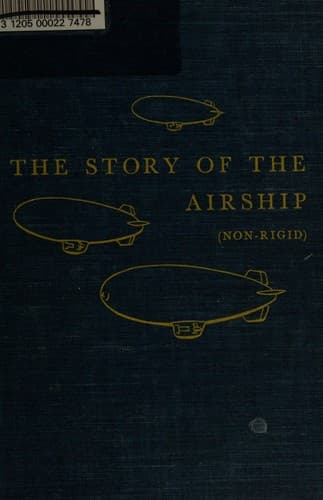
The Story of the Airship (Non-rigid): A Study of One of America's Lesser Known Defense WeaponsAllen, Hugh
History
The Story of the Airship (Non-rigid): A Study of One of America's Lesser Known Defense Weapons
Allen, Hugh
Military airships -- United States
The doldrum period, which made progress difficult, came to an end with
dramatic suddenness. In the year 1927 a youthful pilot flew an airplane,
alone, across the Atlantic ocean, and in the following year a
middle-aged scientist made a round trip from Europe to America by
airship, with 24 people aboard. The imagination of America and the world
took fire. Aeronautics started anew.
Perhaps no events in years have appealed so fully to the public
consciousness or had such dynamic effects. Almost from the day of
Lindbergh’s flight and the Graf Zeppelin’s arrival at Lakehurst,
aeronautical engineers found themselves with money to spend in research
and machinery. Airports unrolled across the carpet of America, night
lighting came in, pilots became business men, appropriations were rushed
through Congress, state assemblies, and city councils, and aeronautics
became Big Business almost over night. The period of inaction and of
reaction was over.
CHAPTER VI
Airship Improvements Between Wars
[Illustration: Docked airship]
The wartime airship was a cigar-shaped gas bag with an airplane cockpit,
open to the weather, slung below. The contrast between it and the sleek,
fast, streamlined Navy airship of today is almost as striking as that
between wartime planes and automobiles and modern ones.
Many improvements have been made, even though the airship has not had
the experience of building thousands of units, as the automobile and
airplane have had, or ample funds for research and experiment. Less than
150 non-rigid airships have been built all told since 1914.
The “B” type blimp, chiefly used in the World War, contained 80,000
cubic feet of hydrogen, though some British and French non-rigids were
built in larger sizes, and the United States Navy “C” ships, toward the
end of the war, had 200,000 cubic feet of lifting gas. These compare
with the 416,000 cubic feet of helium in the new Navy “K” ships. Speed,
under the pressure of war needs moved up from 47 miles in the “B” to
close to 60 in the “C,” but is around 80 in today’s “K” ships.
Wartime ships carried three to five men and a day’s fuel. Today’s carry
eight or ten, enough pilots, radio men, navigators, riggers and
mechanics for two full watches, though normally everyone is on duty
during patrols. The “B” was good for perhaps 900 miles, the “K” for well
over twice that distance.
Wartime ships had to keep the control car well away from the bag to
prevent sparks from igniting the hydrogen gas. A windshield was the
pilot’s only protection from the elements. Modern ships, using
non-inflammable helium, have closed cars, streamlined into the bag,
ample room for navigation and radio, sleeping and eating quarters, even
a photographic dark room, can be heated and noise-proofed.
Public-domain text, read in full here on John Shaqi.
Reviews
Reviews
No reviews yet
Be the first to share your thoughts on this work.
Join the Discussion
Join the discussion
Sign in to leave a comment or review.
Sign InorCreate an account