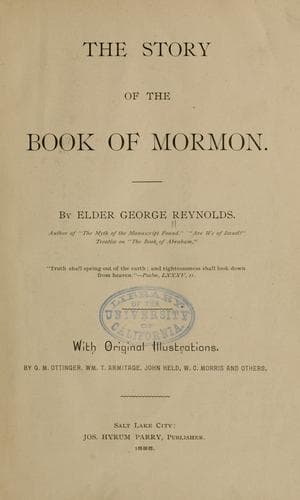
Book of Mormon; Latter Day Saint churches -- Doctrines; Latter Day Saints
Though the laws were strict, they were mercifully and equitably
administered, which gave much greater stability to the government and
respect for the law than if they had been adjudged loosely, and with
partiality towards classes or persons. It has been wisely observed that
it is not the severity of the law but the sureness of the punishment
that deters the evil-doer, and in this respect the Nephite nation had
cause for thankfulness. All men were alike before the law, there were
no privileged classes as in Rome, or in feudal Europe in later years.
Mosiah says, Whosoever has committed iniquity, him have I punished
according to the law which has been given to us by our fathers.
From the charge of king Benjamin to his son Mosiah we learn that
slavery was forbidden. All the inhabitants of the continent being
of the house of Israel, they could not observe the law of Moses and
enslave their brethren.
Murder, robbery, theft, adultery and other sexual abominations were
punished by law, as also was lying or bearing false witness.
Mormon states that in king Benjamin's days the false Christs, etc.,
were punished according to their crimes; but we are not informed if
those crimes consisted in false personation, etc., or in fomenting,
aiding and abetting treason and rebellion, as was almost universally
the habit of those who apostatized from the gospel and sought to
establish false religions in its place. King Benjamin also states that
he had not permitted the people to be confined in dungeons; but we are
uncertain whether to infer from this remark that the king intended his
hearers to understand that he had not done this, as so many tyrants
do, without cause and without trial, or that some other more effectual
means had been found of punishing those transgressors not deemed worthy
of death. We incline to the former opinion.
When the Nephite kingdom was first established the people were so
few that they could not possibly sustain the expenses incidental to
royalty. Thus it became the rule for the kings to sustain themselves.
This unique, though most excellent custom continued as long as the
monarchy lasted, even when the nation had grown rich and numerous. King
Benjamin reminds his subjects that he had labored with his own hands
that they might not be laden with taxes. Of Mosiah, his successor, it
is written that he had not exacted riches of the people and that he had
granted unto his people that they should be delivered from all manner
of bondage.
Public-domain text, read in full here on John Shaqi.
Reviews
Reviews
No reviews yet
Be the first to share your thoughts on this work.
Elsewhere in the archive
Join the Discussion
Join the discussion
Sign in to leave a comment or review.
Sign InorCreate an account