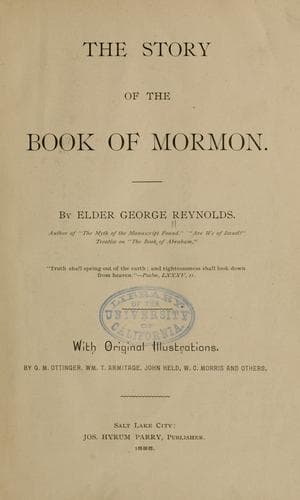
Book of Mormon; Latter Day Saint churches -- Doctrines; Latter Day Saints
We must not forget that, in connection with the civil law, the law
of the gospel was almost unceasingly proclaimed during the whole
period of the monarchy. Various false Christs and false prophets
had arisen at different times, but the power of the priesthood had
remained, ministering in holy things, rebuking iniquity and aiding
in the suppression of vice. The kings of the Nephites, as we before
observed, were, as a rule, men of God, holding the priesthood, and were
often prophets and seers as well as temporal rulers. To this happy
circumstance we must greatly attribute the peace and good order that so
generally prevailed; the respect for the law that was so widespread;
the large amount of liberty accorded to the people and the few abuses
they made of that freedom. To use the idea of the prophet Joseph Smith,
for long years, they were taught correct principles, and they (to a
great extent) governed themselves.
In the course of the centuries, as the people increased and spread far
and wide over the land, they appear to have introduced local customs to
suit their differing circumstances, or in some cases their whims and
notions. Thus, until king Mosiah II. established uniformity by law,
nearly every generation and each section of the country had its own
moneys, weights, measures, etc., which were altered from time to time
according to the minds and circumstances of the people. This custom
naturally caused confusion, annoyance and distrust, and to obviate
these, and possibly greater evils, Mosiah consented to newly arrange
the affairs of the people; and, if we may so express it, to codify the
law. This code became the constitution of the nation under the rule of
the Judges, which limited the powers of the officials and guaranteed
the rights of the people. This compilation was acknowledged by the
people, whereupon the historian remarks, Therefore they were obliged
to abide by the laws which he had made. And from that time they became
supreme throughout the nation. It is stated in another place that this
change was made by the direct command of Jehovah.
FOOTNOTES:
[9] The generally accepted date for the foundation of Rome is 753 B. C.
[10] The eastern and western empires were divided A. D. 395. Alaric,
the Goth, sacked Rome A. D. 410. Britain broke away from the empire A.
D. 418. Gaul, Spain and Africa were soon afterwards lost.
[11] In Sicily alone, goaded by ill-treatment, the slaves rebelled.
Their army numbered 200,000 (B. C. 134-132.)
CHAPTER LIX.
THE LAWS UNDER THE JUDGES--THE VOICE OF THE PEOPLE--ELECTIONS--RIGHTS
OF THE PEOPLE--CHURCH AND STATE--THE CRIMINAL PROCEDURE.
We next enter into the consideration of the law as it existed under the
Judges, gathering our information from various passages in which it is
directly referred to, or wherein some historical incident is narrated
which throws light on its powers and manner of execution.
Public-domain text, read in full here on John Shaqi.
Reviews
Reviews
No reviews yet
Be the first to share your thoughts on this work.
Elsewhere in the archive
Join the Discussion
Join the discussion
Sign in to leave a comment or review.
Sign InorCreate an account