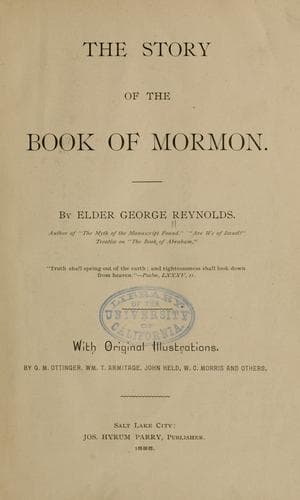
Book of Mormon; Latter Day Saint churches -- Doctrines; Latter Day Saints
From the death of king Mosiah II. (B. C. 91), the governmental
authority was vested in a chief judge and other subordinate judges
and officers, all of whom were elected by the voice of the people,
to judge according to the laws which had been given to and accepted
by the people. Their authority was defined by the law (the code of
Mosiah), but within the bounds therein prescribed they appear to have
held unrestricted powers. This was especially so in the case of the
chief judge. No civil council or parliament divided with the chief
executive the authority to make war or conclude peace, to decide the
terms of treaties, or frame enactments for the regulation of public
affairs. No direct statement is made of the length of the term that a
judge remained in office, but from the historical narrative we gather
the idea that he was elected for life or during good conduct. We have
instances of judges resigning, but none of their removal by the people
because their term of office had expired. Each city or land appears to
have had its chief judge or ruler as well as its inferior magistrates,
all of whom were responsible to the chief judge of the whole nation,
whose seat of government was located in the Nephite capital, Zarahemla,
when the city was not in the hands of Lamanites or traitors.
The manner of conducting elections is not clearly defined. The result
is always spoken of as the voice of the people. The mode of procedure
was uniform, that is, it was the same throughout the land. In the
election of the first chief judge (Alma the younger), the people
assembled in bodies throughout all the land to cast in their voices,
which conveys the impression that they declared their choice _viva
voce_, or by acclamation rather than by lot or ballot. It is quite
possible that the methods were entirely dissimilar to any known at
modern elections; this, however, is but conjecture.
When the sentiments of the people were greatly divided and party
feeling ran high, the opposing factions assembled in separate bodies
throughout the land to cast in their voices, as in the attempt to make
Amlici king. The decisions of the people in these assemblies or mass
meetings were laid before the judges, who proclaimed the result. In
cases where the petition was made for any particular object, or for a
change in the law, the judge directed that a special election (if we
may so term it) be held, and the results were proclaimed according to
the voice of the people, as a whole, or if they were divided, according
to the voice of the majority.
Public-domain text, read in full here on John Shaqi.
Reviews
Reviews
No reviews yet
Be the first to share your thoughts on this work.
Elsewhere in the archive
Join the Discussion
Join the discussion
Sign in to leave a comment or review.
Sign InorCreate an account