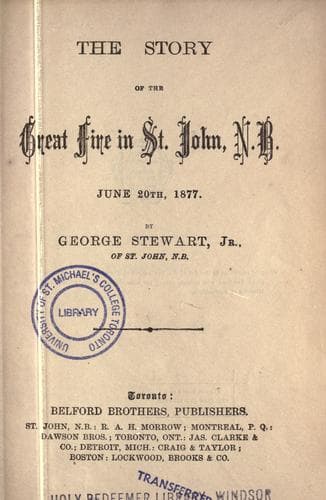
The Story of the Great Fire in St. John, N.B., June 20th, 1877Stewart, George
History
The Story of the Great Fire in St. John, N.B., June 20th, 1877
Stewart, George
Saint John (N.B.) -- Fire, 1877
The fire along Germain Street was of great volume, and dealt out
destruction in a thoroughly wholesale manner. A good many buildings of
more than ordinary note were situate in this pleasant street, and to
these may be added a large number of churches, some of them being of
especial importance in an historical point of view. The fire came along
briskly, carrying Foster's Corner, Foster's shoe store, and the little
buildings adjoining, till it reached Dr. Ring's residence, the old
Disbrow property, the first brick house in St. John. The doctor had
lately improved it by extensive building operations, but in an hour or
two hardly a fragment remained to mark the spot, save parts of the
well-built walls and the tall chimneys. Mrs. Chas. K. Cameron's
millinery store and Hamilton & Lounsbury's place of business were in the
two stores in this building, and they very soon were lost to sight.
Lordly, Howe & Co.'s furniture warerooms, filled with new stock, were
greedily devoured by the flames, and Geo. Hutchinson, jr., who kept the
time ball in working order, lost all his jewelry and stock. The precious
stones and gold and silver ornaments in his safe were totally ruined
also. The Mansion Hotel, a small boarding house, was soon among the
general mass of debris, and the fire whizzed across the street, and
directed its entire force on Old Trinity. First the steeple went, and
then the whole body of the old church was in a sheet of flame, and there
was barely time left to save the historic Royal Arms which Captain Frank
B. Hazen got out of the building, and a few prayer books in the vestry,
and the minister's surplices, which Colonel Chas. R. Ray rescued from
destruction. The communion plate was in a safe, and it too was saved;
but this was all. During the burning of this sacred edifice the greatest
consternation prevailed among the people who lined the streets. Now
surely there was no resisting the fire. The hoarse roar of the tornado
of flame seemed to sound like a mocking laugh, and when the rafters of
the oldest church in the city fell with a dull thud, all felt as if a
friend had been torn ruthlessly from their gaze. Many exhibited real
emotion; and there were women who cried that afternoon, as they thought
of this last relic of their loyalist forefathers being swept away in the
cruel and all-devouring fire. Trinity Church has a very remarkable
history of its own, and the picture which we supply of it will be
perhaps the most attractive of our illustrations to the great mass of
the residents of the city. It was ever a monument of the piety and
religious tenets of our first settlers. A heritage which they left to
their children. It never laid claims to architectural beauty, but it was
commodious and homely; and men felt while inside its grand old walls
that there was something more than the mere name in religion after all,
and the word which they heard was true and good. The Loyalists who
Public-domain text, read in full here on John Shaqi.
Reviews
Reviews
No reviews yet
Be the first to share your thoughts on this work.
Join the Discussion
Join the discussion
Sign in to leave a comment or review.
Sign InorCreate an account