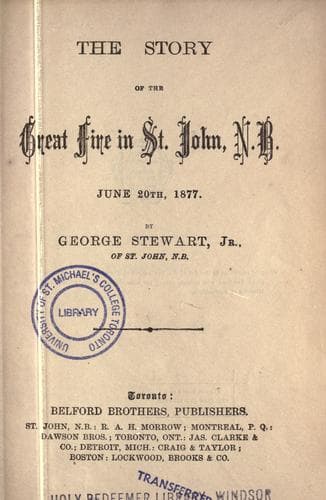
The Story of the Great Fire in St. John, N.B., June 20th, 1877Stewart, George
History
The Story of the Great Fire in St. John, N.B., June 20th, 1877
Stewart, George
Saint John (N.B.) -- Fire, 1877
settled here in 1783, on that memorable 18th of May, were composed of
that stuff which the poet tells us warriors sometimes feel, and they
diligently set to work to build on this sterile, rocky soil a city that
future ages would acknowledge. They had thrift, integrity, great zeal,
enterprise and piety, and these attributes were their strongest points.
The man who possesses all these characteristics can give battle to the
world and he will conquer. They had true courage in them, these
pioneers. They had stability, nerve and character, and were just the men
to found a city and plant the seeds of civilization in a community. They
erected simple houses at first, and then a church was built in which
they could worship that God who had befriended them and journeyed with
them to their new homes. The first church was erected in Germain Street,
between Duke and Queen Streets, in the lot where Mr. James McMillan
lived till he was burned out of it the other day. The faith adopted here
was that of the Church of England--as the major portion of the Loyalists
were of that persuasion. When the city lots were divided, the "Old
Burial Ground" was laid aside for church and burial purposes, and at the
south-west corner--where the court-house now stands--it was intended to
build a church, and a frame for that object was obtained. The fire of
1784, however, passed over this section of the city, and the founders
changed their ideas about the locality in which the projected edifice
should stand. The Germain Street building had not been consecrated, and
the people continued to worship there until 1791, when the Trinity
Church was erected. The first church then continued to be occupied by
various denominations, by the Methodists first, and then by the
Baptists, until meeting-houses and chapels of their own could be built;
latterly it was used as a private dwelling-house and school-house. The
first sermon in Trinity was preached on Christmas Day, 1791, by Rev. Dr.
Mather Byles, rector. The following year a bell was put up, and, in 1803
or 1804, stoves, for the first time, were placed in the church. The
first Bishop of Nova Scotia, Right Reverend Dr. Charles Inglis,
performed the consecration services of the church. This eminent divine
was grandfather of Major-General Sir John Inglis, whose deeds of valour
at Lucknow will never be forgotten while glorious exploits in military
history live in the memory of men. Thomas Horsfield and Fitch Rogers
were the first church-wardens of Trinity, and the vestrymen were Hon.
Gabriel Ludlow, Ward Chipman, Munson Jarvis, Thomas Whitlock, Nathan
Smith, Thomas Elmes, William Hazen, Colin Campbell, Nehemiah Rogers,
Isaac Lawton, Thomas Bean, and Samuel Hallet; vestry clerk, Colin
Campbell; sexton, James McPherson. General Coffin and Thomas Whitlock
gave the ground for the building, and Messrs. Bean & Dowling were the
builders. This Mr. Bean was the gentleman who, in June, 1811, when the
Public-domain text, read in full here on John Shaqi.
Reviews
Reviews
No reviews yet
Be the first to share your thoughts on this work.
Join the Discussion
Join the discussion
Sign in to leave a comment or review.
Sign InorCreate an account