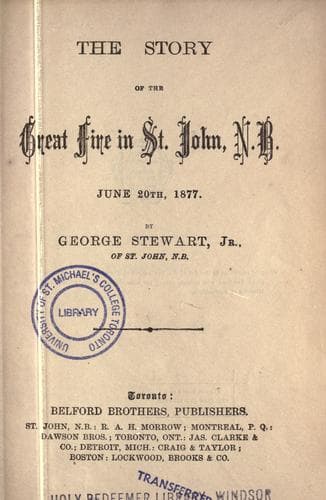
The Story of the Great Fire in St. John, N.B., June 20th, 1877 — John Shaqi
The Story of the Great Fire in St. John, N.B., June 20th, 1877Stewart, George
History
The Story of the Great Fire in St. John, N.B., June 20th, 1877
Stewart, George
Saint John (N.B.) -- Fire, 1877
church wanted to borrow £200, agreed to lend it that sum on the express
condition that the insurance policy then on the building should be at
once cancelled. An order was passed cancelling the policy without delay.
Thus was Trinity for a while without insurance. Had Mr. Bean's ideas
prevailed to-day the congregation would, in all likelihood, mourn the
loss of $20,000, which is the amount that was on the building at the
time of the fire. When the edifice was finished, it was found to be of a
peculiar shape, and its breadth was out of all proportion to its length.
This was not an accident, however, for the builders wisely thought the
city would grow, and that as the requirements of the people needed it,
the church might be made larger. Little change had taken place in the
interior arrangements of the church at the time of its destruction. The
same pews had stood over four score of years, and all the alteration
that was made was a slight cutting down of the backs of some of the
centre ones. The side pews remained the original height. For
seventy-three years the old organ has been in constant use in Trinity.
It was brought from London in 1804, and cost a good round sum. The
freight on it alone was one hundred guineas, but the owner of the vessel
which brought it over, Hon. Wm. Pagan, remitted the amount back to the
corporation of the church. To its last days, this organ has been a good
instrument. In 1792, Mr. William Thomson presented Trinity with a bell,
for which he received a cordial vote of thanks. This bell was in active
service till 1857, when the bell which tolled a few days ago its last
sad peals, was mounted in the belfry. The town-clock, as every one was
accustomed to call the clock which told of the passing hours, too, has a
history. In 1810, Mr. John Venning erected the tower and cupola. He
had nearly completed his work one May morning, when owing to a light
fall of snow the staging became slippery, and when Mr. Venning stepped
upon it he slipped from it to the roof, and from thence to the ground,
where he was picked up dead. In 1812, the clock was placed in position,
and has remained there, till the events of Wednesday ended its career.
Barraud, of Cornhill, London, was the maker, and it cost £221 19s.
sterling; the Common Council voted £50 towards it. Up to 1814, the
church paid for having the time-piece wound, and in this year the
winding cost £6 15s., when the church people decided that they would no
longer attend to this service, and maintained that the commonalty should
see to it. The Council, on December 24th, 1814, resolved to act on the
suggestions of the Church corporation, and took upon themselves the duty
of keeping the clock wound up and in repair. Edward Taylor assisted in
putting up the clock and assumed control of it, till Mr. Wm. Hutchinson,
father of Geo. Hutchinson, jr., took charge of it. Previous to 1857, it
had three dials, but in this year a fourth was added, and a spire was
placed upon the church.
Public-domain text, read in full here on John Shaqi.
Reviews
Reviews
No reviews yet
Be the first to share your thoughts on this work.
Join the Discussion
Join the discussion
Sign in to leave a comment or review.
Sign InorCreate an account