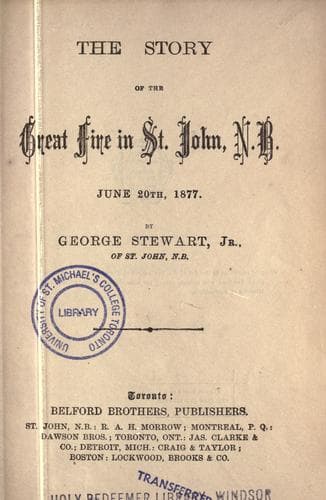
The Story of the Great Fire in St. John, N.B., June 20th, 1877Stewart, George
History
The Story of the Great Fire in St. John, N.B., June 20th, 1877
Stewart, George
Saint John (N.B.) -- Fire, 1877
After this temple of art was overthrown the fire burned along the square
till it struck the Hazen building, now owned by C. M. Bostwick, who had
but recently renovated it from top to bottom. But this corner house was
too much for the fire, the fiend was baffled in its object, and though
late through the night it made several inefficient attempts to raise its
head, when the morning dawned, the Hazen Building was still safe and
defiant, for the flames were at its feet helpless and weak. The fire
crept along the square and passed the burned district when it divided
itself into two wings. The right body went up Leinster Street, and the
left wing proceeded around by the square, attacked the Court House, was
repulsed, when it burned the buildings adjoining No. 2 Engine House, and
made a sortie in rear of the jail. It was well nigh successful in its
object, and indeed a portion of this edifice was burned. The prisoners
were made secure, and a grand exit took place under the immediate
supervision of Deputy Sheriff Rankine. Two or three of the culprits
managed to escape, but they returned next day, after wandering about the
city, and gave themselves up, fearing lest they would starve in the
desolate and destitute town. The jail successfully resisted the flames,
but not so the old Temperance Hall which stood beside it. This
antiquated and wholly unattractive meeting-house was put up about thirty
years ago, and was originally intended for a school in connection with
the poor-house, which stood on the corner of Carmarthen and East King
Streets. The Temperance Order was organized in St. John, May 12th, 1847,
and the leading men were Hon. S. L. Tilley, C.B., Lieut.-Governor of the
Province, Chas. A. Everett, the Smilers, John Rankine, W. H. A. Keans,
S. B. Paterson, O. D. Wetmore, and of late years, Samuel Tufts, Edw.
Willis, A. G. Blakslee, J. A. S. Mott, and Sheriff Harding. The
organization met in King Street till they were burned out, after which
they settled in the Temperance Hall near the jail, where they have
remained ever since. The interior of this block was burned, and only the
Court House, which was opened for the first time for Supreme Court uses
by Judge Botsford at the January Circuit of 1830, the Registry Office,
and the City Prison were left. It was only by dint of the most strenuous
exertions that these buildings were kept proof against the levelling
qualities of the left wing, which again and again reared its front till
it was firmly laid low at eleven in the evening of that terrible day.
The old poor-house in Carmarthen Street was hemmed in by the united
forces of left and right, and it easily succumbed without even a show of
resistance. The defence of the office of the Superintendent of Water
Supply[N] was one of the memorable events in connection with the history
of the fire. In the yard people from all quarters of the city had stored
their goods in the vain hope that the fire could never reach them. The
Public-domain text, read in full here on John Shaqi.
Reviews
Reviews
No reviews yet
Be the first to share your thoughts on this work.
Join the Discussion
Join the discussion
Sign in to leave a comment or review.
Sign InorCreate an account