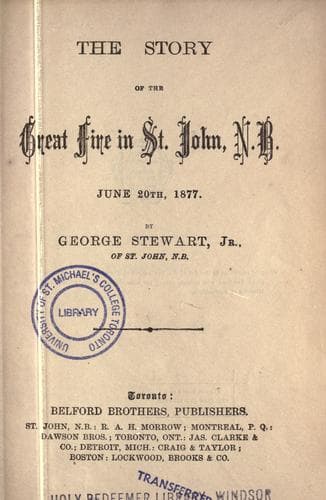
The Story of the Great Fire in St. John, N.B., June 20th, 1877Stewart, George
History
The Story of the Great Fire in St. John, N.B., June 20th, 1877
Stewart, George
Saint John (N.B.) -- Fire, 1877
In this connection, a brief sketch of the water supply of St. John will
not be without interest. It is only half a century ago that the
inhabitants of this city were dependent on wells for the water which
they drank and used. Even at later date than that it used to be sold
about the streets from tall casks, at a penny a bucketful. The chief
wells were in King's Square, Blockhouse Hill--the vantage ground of many
a well-contested fisticuff battle between the rising generation;
Princess Street, near Charlotte; Queen Square, the foot of Poor House
Hill, which in winter made such a splendid coasting road; and in
Portland close by the first public hydrant, now in Main Street. In
1820, agitation was made for a better system of water supply; but it was
not until 1825 that the question took definite shape, and an Act for the
incorporation of a water company, with a capital of £10,000 passed the
Legislature. Surveys were at once made, and estimates were laid before
the stockholders, but the capital subscribed was deemed insufficient to
enable them to go on with the work in hand. The money was accordingly
lent out on interest until the next year, when each stockholder received
back the sum he had paid in, with three per cent. added. A number of new
wells were sunk at once, and every effort made to secure for the people
a fuller supply. In 1832, Hon. William Black, Nehemiah Merritt, James
White, John Ward, George D. Robinson, Thomas Barlow, Hugh Johnston, John
M. Wilmot, James Hendricks, Thomas Millidge, Robert W. Crookshank,
Zalmon Wheeler, Robert Parker, William B. Kinnear, Richard Sands,
Lauchlan Donaldson, Charles Simonds, James T. Hanford, William Leavitt,
and Noah Disbrow had an Act passed for the Incorporation of the St. John
Water Company. It started with a subscribed capital of £20,000, five per
cent. of which was to be paid in a year from the date of the passing of
the Act. The shares were placed at £5 each. Directors were to be elected
every year, and consist of thirteen in number, and seven of the old
directors were to remain in office each year. In 1834, a new Act was
passed, amending the one which was sanctioned two years previously, but
the Company was not regularly organized until 1837. Colonel Baldwin,
C.E., during this year, made surveys, and on his advice the first
practical attempt at bringing the water into the city from Lily Lake was
made. An engineer was appointed, and, under his management, the first
City Water Works were built. The water was not brought, as in the
opinion of eminent engineers it should have been, directly from Lily
Lake to the city by its own gravitation, but was taken from the tail of
Gilbert's Mill, and conducted thence by a sluice to a reservoir or a
cistern, which was placed a few yards to the south-west of the
Marsh-bridge. An engine and pumping-house was erected over the cistern,
a steam-engine and gear were procured, and the water was sent through a
Public-domain text, read in full here on John Shaqi.
Reviews
Reviews
No reviews yet
Be the first to share your thoughts on this work.
Join the Discussion
Join the discussion
Sign in to leave a comment or review.
Sign InorCreate an account