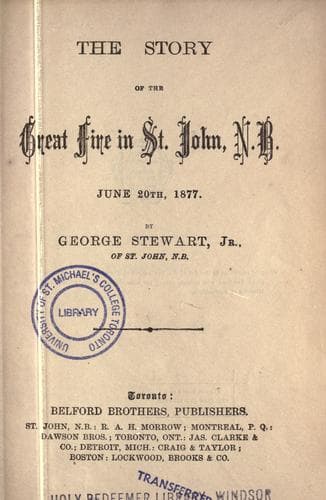
The Story of the Great Fire in St. John, N.B., June 20th, 1877Stewart, George
History
The Story of the Great Fire in St. John, N.B., June 20th, 1877
Stewart, George
Saint John (N.B.) -- Fire, 1877
ten-inch main to the reservoir, which was on Block House Hill. The water
was first brought through the pipes to the city in October, 1838. The
supply passed through a very limited number of pipes, and the
inhabitants, up to 1850, could only get water two hours each morning.
The Company, from its first organization, suffered the pangs of
financial troubles. The stock had met with many takers, who subscribed
readily, but when called on for their payments failed to respond. A loan
of £5,000 was received from the Legislature, which relieved the company
somewhat for the nonce. In 1850, an appeal was made to the citizens on
public grounds, and they were earnestly solicited to take up the new
shares which were offered. The money from this source was to be applied
to the extending of the works to, and bringing the water from, Little
River at Scott's Mill, five miles away from the city. This course had
been recommended by Chas. W. Fairbanks, Esq., C.E., of Halifax, under
whose supervision the water had been introduced into that city. The city
took up 900 shares, and private individuals bought the balance. The site
at Scott's Mill was purchased, a small dam was built, and a twelve-inch
main, four and a half miles in length, was laid. This main the company
connected with the ten-inch main that was laid in 1837-8. The same main
is still perfect, and to-day works as well as ever. In 1852 an Act was
passed, authorizing a further increase in the capital to the amount of
£10,000, to be made preference stock. This was necessary to meet the
growing demand of consumers, and to enable the company to extend their
pipes through the streets. In April, 1855, an Act was passed to allow
the company to transfer their property and works to the City Corporation
and Sessions. This step was deemed prudential for many reasons, the
chief of which was the great difficulty the company experienced in
running the water and sewerage systems separately. The conveyance was
made. The Act authorized the Commissioners to issue debentures, bearing
six per cent. interest, payable half-yearly, and redeemable at periods
not exceeding forty years from their date. Two of the commissioners, one
of whom should be chairman, were to be appointed by the Common Council,
and another by the County Sessions. John Sears, Esq.--who lost in the
great fire all his private papers, historical recollections which he had
been collecting for forty years, and a number of rare oil paintings and
portraits, an irreparable loss--was the first chairman, with the late
John M. Walker, and John Owens, Esquires, as Commissioners. In 1864,
Edward E. Lockhart, Esq., the present chairman, was appointed to the
office, and the late Thomas King, and J. D. Woodworth, Esquires,
Commissioners. On Mr. King's death, Mr. Stephen K. Brundage was
appointed, and Mr. William Seely took Mr. Woodworth's place.
[Illustration: VIEW FROM QUEEN SQUARE.]
Public-domain text, read in full here on John Shaqi.
Reviews
Reviews
No reviews yet
Be the first to share your thoughts on this work.
Join the Discussion
Join the discussion
Sign in to leave a comment or review.
Sign InorCreate an account