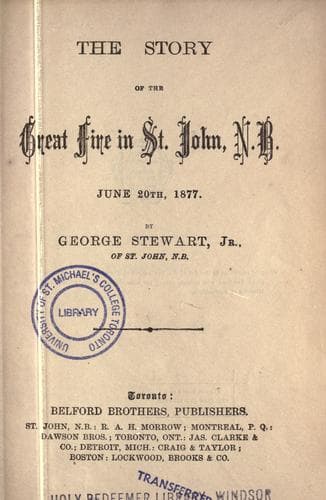
The Story of the Great Fire in St. John, N.B., June 20th, 1877Stewart, George
History
The Story of the Great Fire in St. John, N.B., June 20th, 1877
Stewart, George
Saint John (N.B.) -- Fire, 1877
The first step taken by the commission was the improvement of the works.
The dam at Little River reservoir was built higher and stronger, and
during the progress of operations on it, it burst twice, and Gilbert
Murdoch, Esq., the chief engineer, narrowly escaped drowning on one of
these occasions. A twenty-four inch main was laid from the reservoir,
and almost at the same time, and for most of its length, beside the ten
inch main put down in 1850. This came across the Marsh bridge, and was
connected, along with the twelve inch main, with an iron chamber, from
which the water flowed into the original ten inch main, running up
Brussels Street to the reservoir; a twelve inch main up Waterloo Street;
a twelve inch main which went by the city road to Portland, and mains
which have been put down later. The reservoir in Leinster Street was
also thoroughly improved.
A new twelve inch main was laid up Erin Street, through St. Patrick and
Wentworth Streets, to Princess, in 1868. The twelve inch main that is
laid up Waterloo street, also goes along Sydney to Princess streets, and
the Portland twelve inch main is extended nearly to the spot where the
defunct street railway stables were, on Main Street, where an eight inch
pipe joins it, and carries the water as far as Rankin's mill, by way of
the steamboat wharves.
This brings the history of the water supply down to about nine years
ago. Since that time, the progress which has been made upon it has been
great and rapid. A vast amount of money and skill have been expended to
bring the works down to the splendid state of perfection in which they
are now. The water supply is excellent, and the system of sewerage is
unsurpassed anywhere. Under great natural difficulties the work has been
prosecuted, but the engineers and their workmen, by dint of
perseverance, have surmounted the many obstacles which beset them on
every side. Before leaving this subject, a remark or two may be made
about the source from which our people receive their supply of water.
The Victoria spring is situate on a hill-side, about a mile this side of
Loch Lomond. Its waters form the head of Little River. Lake Donaldson is
near the spring, and the Victoria is supposed to drain it. The stream
from the spring flows into Douglas Lake, a sheet of water on the south
side of the Loch Lomond road, eight miles from the Marsh Bridge. It is
three miles from Lake Douglas to the reservoir. Lake Latimer, one of the
feeders of Little River on the south side, is nearly as high as Loch
Lomond. Its waters are as clear as crystal. Lake Buck, which also flows
into Little River, lies about a quarter of a mile away from it. Long's
Lake which is on the right side of Little River as it flows towards
Courteney Bay, is about a mile to the north of Loch Lomond Road, and
empties itself into the reservoir. That a still further head may be had
when wanted, the Commissioners purchased land through which they can
bring a strong supply of water from Loch Lomond.
Public-domain text, read in full here on John Shaqi.
Reviews
Reviews
No reviews yet
Be the first to share your thoughts on this work.
Join the Discussion
Join the discussion
Sign in to leave a comment or review.
Sign InorCreate an account