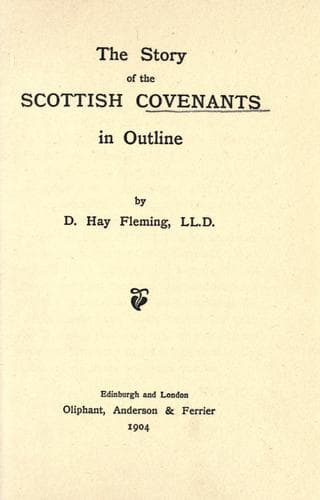
The Story of the Scottish Covenants in OutlineFleming, David Hay
History
The Story of the Scottish Covenants in Outline
Fleming, David Hay
Covenanters; Covenanters -- Scotland -- History; Covenants (Church polity); Scotland -- Church history
had bound themselves, or assisted, to set forward and execute the cruel
decrees of the Council of Trent, injuriously called, by the adversaries
of God’s truth, “The Haly League.” By this time the “Tulchan Bishops”
had been obtruded on the Church of Scotland.
[Sidenote: The King’s Confession]
All the earlier covenants were eclipsed in interest and importance by
the one drawn up by John Craig, and commonly called “The King’s
Confession,” sometimes “The Second Confession of Faith,” and sometimes
“The Negative Confession.” In it the corruptions of the Papacy are
denounced and renounced in terse language and with refreshing vigour. As
John Row puts it: “This wes the touch-stone to try and discern Papists
from Protestants.” And yet, notwithstanding its searching and solemn
words, it failed in at least one notable instance as a touch-stone. The
original document, signed by James the Sixth and his household on the
28th of January 1580-81, found its way to France, but fortunately was
sent back again to this country—to Scot of Scotstarvit—and is now in the
Advocates’ Library. This covenant was subscribed in 1581 by all ranks
and classes of the people.
Because of “the great dangers which appeared to hang over the kirk and
countrie,” a special meeting of the General Assembly was convened on the
6th of February 1587-8. In the fifteenth session, it was agreed that
ministers should “travell diligentlie with the noblemen, barons, and
gentlemen, to subscribe the Confession of Faith.” In accordance with
this resolution, the Negative Confession was again signed by the King,
and nearly a hundred other persons, including several of the leading
nobles, on the 25th of February, at Holyrood.
[Sidenote: The General Band]
The dread inspired by the approach of the Spanish Armada in 1588 led to
the preparation of another covenant, known as “The General Band.” The
subscribers did “solemnly swear and promise to take a true, effald and
plain parte with his Majestie amongst ourselves, for diverting of the
present danger threatned to the said [true and Christian] religion, and
his Majestie’s estate and standing depending thereupon.” There is record
evidence to show that it was subscribed by the King “and divers of his
Esteatis” before the 27th of July 1588.
[Sidenote: Band of 1589]
This was a time of special bands. At Aberdeen, on the 30th of April
1589, the King and many others subscribed a band, by which they bound
themselves together “for the defens and suretie of the said trew
religioun, his Hienes persone and estate thairwith conjoynit”; and for
the pursuit of “Jesuittis, Papistis of all sortis, thair assistaris and
pairttakaris,” including the Earls of Huntly and Errol, who had “cum to
the feildis with oppin and plane force and displayit baner, for the
persute, ruting-oute and exterminioun of his Majestie, and all uthiris
his gude and loving subjectis, trew professouris of the Evangell.”
[Sidenote: Covenanting in 1590]
Public-domain text, read in full here on John Shaqi.
Reviews
Reviews
No reviews yet
Be the first to share your thoughts on this work.
Join the Discussion
Join the discussion
Sign in to leave a comment or review.
Sign InorCreate an account