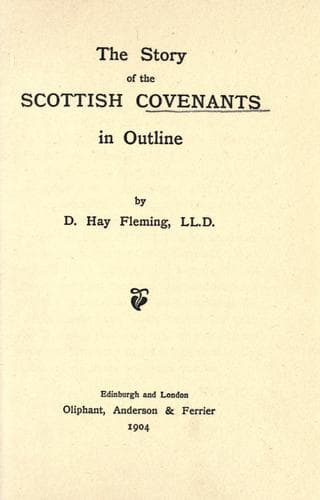
The Story of the Scottish Covenants in OutlineFleming, David Hay
History
The Story of the Scottish Covenants in Outline
Fleming, David Hay
Covenanters; Covenanters -- Scotland -- History; Covenants (Church polity); Scotland -- Church history
These articles really formed a band for subverting the mass, destroying
monuments of idolatry, setting up the true religion through the whole
realm, increasing ministers’ stipends, reforming schools, colleges, and
universities, easing the poor of their teinds, punishing vice, crimes,
and offences, especially the murder of Darnley, defending the young
prince, bringing him up in the fear of God, and obliging future kings
and rulers to promise, before their coronation and inauguration, to
maintain, defend, and set forward, the true religion. The subscribers
also consented and offered “to reforme themselves according to the Booke
of God.” In all they numbered about eighty. Of these, two or three
certainly knew of the plot against Darnley before it was carried out;
and they may have subscribed these articles to avert suspicion.
[Sidenote: St Bartholomew’s Massacre]
[Sidenote: Proposed Band]
[Sidenote: Test Of Loyalty]
The dreadful massacre of the Huguenots, begun in Paris on St
Bartholomew’s day 1572, excited consternation and horror in Scotland.
Believing that all the other Protestants in Europe were to be similarly
dealt with, the Privy Council summoned a convention, to be held at
Edinburgh on the 20th of October, to consider the impending danger and
the means by which it might be averted. Unfortunately for the success of
the convention, the lieges had been summoned to meet at Jedburgh on the
22nd to make a raid upon the border thieves; and the Earl of Mar, then
Regent, was drawing near his end at Stirling. None of the nobles
and few of the lairds attended the convention; but a number of
proposals were agreed to, that they might be sent to the Regent
and the Privy Council. One of these proposals was that a public
humiliation, or fast, should be held throughout the whole of Scotland
during the last eight days of November. Another was that the Protestants
of the realm should enter into a solemn band, that they might be ready
on all occasions to resist the enemy. There is evidence to show that the
fast was observed in Edinburgh; but, if the band was ever drawn up, no
copy of it seems to have survived, nor any record of its having been
entered into. The suggestion, however, was not fruitless. In the
following January, Parliament enacted that no one should be
reputed a loyal subject to the King, but should be punished
as a rebel, who did not profess the true religion; and that
those who had made profession thereof, and yet had departed from their
due obedience to his Majesty, should not be received to his mercy and
favour, until they anew gave confession of their faith; and promised to
continue “in the confessioun of the trew religioun” in time coming, and
to maintain the King’s authority; and also that they would, “at the
uttermest of thair power, fortifie, assist and mantene the trew
preichouris and professouris of Christis religioun,” against all enemies
and gainstanders of the same, of whatever nation, estate, or degree, who
Public-domain text, read in full here on John Shaqi.
Reviews
Reviews
No reviews yet
Be the first to share your thoughts on this work.
Join the Discussion
Join the discussion
Sign in to leave a comment or review.
Sign InorCreate an account