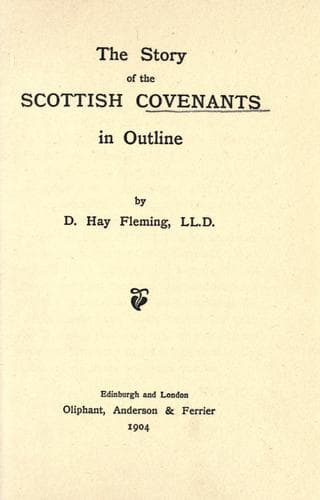
The Story of the Scottish Covenants in OutlineFleming, David Hay
History
The Story of the Scottish Covenants in Outline
Fleming, David Hay
Covenanters; Covenanters -- Scotland -- History; Covenants (Church polity); Scotland -- Church history
James the Sixth’s hankering for Prelacy and its ritual continued to
increase after he crossed the Tweed in 1603. By the summer of 1610, “the
restoration of episcopal government and the civil rights of bishops” had
been accomplished; but, according to the best-informed of Scottish
Episcopalian historians, “there was yet wanting that without which, so
far as the Church was concerned, all the rest was comparatively
unimportant.” The Archbishop of Glasgow, and the Bishops of Brechin and
Galloway, were sent up, however, to the English court, and on the 21st
of October “were consecrated according to the form in the English
ordinal.” This qualified them on their return to give “valid ordination”
to the Archbishop of St Andrews (George Gladstanes) and the other
bishops. Gladstanes seems to have felt duly grateful to the King, whom
he addressed as his “earthly creator.” The Court of High Commission had
already been erected; and in 1612 Parliament formally rescinded the Act
of 1592, regarded as the charter of Presbytery. A General Assembly
held at Perth, in August 1618, agreed by a majority to the five
articles, afterwards known as “the Articles of Perth”; and they were
ratified by Parliament in August 1621.[2]
-----
Footnote 2:
By the five articles of Perth—
(1) Kneeling at the Lord’s Supper was approved;
(2) Ministers were to dispense that sacrament in private houses,
to those suffering from infirmity or from long or deadly
sickness;
(3) Ministers were to baptise children in private houses in
cases of great need;
(4) Ministers were, under pain of the bishop’s censure, to
catechise all children of eight years of age, and the children
were to be presented to the bishop for his blessing;
(5) Ministers were ordered to commemorate Christ’s birth,
passion, resurrection, ascension, and the sending down of the
Holy Ghost.
[Sidenote: Revolt of 1637]
When Charles the First ascended the throne, in 1625, he found that the
northern church still lagged behind its southern sister. He resolved to
supply the defects, and the projects which he laid for this purpose had
a considerable influence on the events which subsequently brought him to
the block. Had he shown more caution and less haste, he might possibly
have succeeded in his attempts on the Scottish Church; but in Laud he
had an evil adviser. The storm burst in the High Church (St Giles) of
Edinburgh, when Dean Hanna tried to read the new liturgy, on the 23rd of
July 1637. With this tumult the name of Jenny Geddes has been
associated. The Presbyterian party, so long down-trodden, began to
assert their rights; and, finding that they would be better able to
withstand opposition if closely bound together, they determined to fall
back on the plan of their ancestors by entering into a solemn covenant.
Public-domain text, read in full here on John Shaqi.
Reviews
Reviews
No reviews yet
Be the first to share your thoughts on this work.
Join the Discussion
Join the discussion
Sign in to leave a comment or review.
Sign InorCreate an account