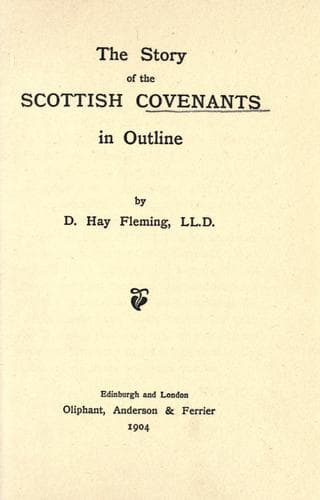
The Story of the Scottish Covenants in OutlineFleming, David Hay
History
The Story of the Scottish Covenants in Outline
Fleming, David Hay
Covenanters; Covenanters -- Scotland -- History; Covenants (Church polity); Scotland -- Church history
As the basis of this covenant the King’s Confession of 1580-81 was
chosen, and to it two additions were made, the first, prepared by
Archibald Johnston of Warriston, is known as “the legal warrant,” and
the second, drawn up by Alexander Henderson of Leuchars, was the bond
suiting it to the occasion.
[Sidenote: National Covenant]
With these additions it was, and still is, known as “The National
Covenant”; and in that form it was sworn to and subscribed by thousands
of people, in Greyfriars Church and churchyard, on the 28th of February
1638, and by hundreds of ministers and commissioners of burghs next day.
Copies were sent all over the country, and were readily signed in almost
every district. The enthusiasm was unbounded. The King could not prevail
on the swearers to resile from their position, and therefore tried to
sow dissension among them by introducing a rival covenant. For this
purpose he likewise selected the King’s Confession of 1580-81; but
instead of Johnston’s and Henderson’s additions, he substituted the
General Band of 1588; and so the two documents combined in 1590 were
again brought together. This attempt to divide the Covenanters utterly
failed. The people now called the covenant completed by Johnston and
Henderson, “The Noblemen’s Covenant”; and the one sent out by Charles,
“The King’s Covenant.”
[Sidenote: Glasgow Assembly]
The General Assembly which met at Glasgow on the 21st of November 1638
was dissolved by the Royal Commissioner; but Henderson, who was
moderator, pointed to the Commissioner’s zeal for an earthly king as an
incentive to the members to show their devotion to the cause of their
heavenly King; and the Assembly continued to sit until it had condemned
and annulled the six General Assemblies held between 1606 and 1618, and
had made a clean sweep of the bishops, their jurisdiction, and their
ceremonies.
Next summer Charles marched with an English army into Scotland, only to
find a strong force of Covenanters, under Alexander Leslie, encamped on
Duns Law. Deeming discretion the better part of valour, the King entered
into negotiations, and the Treaty of Berwick followed. By it he agreed
that a General Assembly should be held in August, and thereafter a
Parliament to ratify its proceedings. The Assembly met, and by an Act
enjoined all professors and schoolmasters, and all students “at the
passing of their degrees,” to subscribe the Covenant. By another Act it
rejected the service-book, the book of canons, the High Commission,
Prelacy, and the ceremonies. Parliament duly met, but was prevented from
ratifying the Acts of Assembly by the Royal Commissioner, who adjourned
it from time to time, and finally prorogued it until June 1640.
[Sidenote: Assembly of 1639]
Public-domain text, read in full here on John Shaqi.
Reviews
Reviews
No reviews yet
Be the first to share your thoughts on this work.
Join the Discussion
Join the discussion
Sign in to leave a comment or review.
Sign InorCreate an account