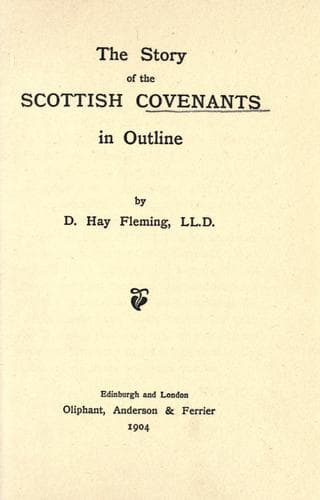
The Story of the Scottish Covenants in OutlineFleming, David Hay
History
The Story of the Scottish Covenants in Outline
Fleming, David Hay
Covenanters; Covenanters -- Scotland -- History; Covenants (Church polity); Scotland -- Church history
An international Protestant league was not a new idea. The Convention,
which met at Edinburgh on the 20th of October 1572, had suggested that
a league and confederacy should be made “with our nychtbouris of
Ingland and uther cuntries reformit and professing the trew
religioun,” that we and they be joined together in mutual amity and
society to support each other, when time or occasion shall serve, “for
mantenance of religioun and resisting of the enemies thairof.” In
1585, the Scottish Parliament (understanding that divers princes and
potentates had joined themselves, “under the Pape’s auctoritie, in a
maist unchristiane confederacie, aganis the trew religioun and
professouris thairof, with full intent to prosecute thair ungodlie
resolutioun with all severitie”) authorised the making of a Christian
league with the Queen of England, to be, in matters of religion, both
offensive and defensive, even against “auld freindis and
confederatis.” The league, or treaty, was finally concluded by
commissioners, at Berwick-on-Tweed, on the 5th of July 1586.
[Sidenote: The Covenant enjoined]
In October the Commission of the General Assembly ordered that it should
be forthwith printed, and gave instructions for the swearing and
subscribing, presbyteries being ordered to proceed with the censures of
the kirk “against all such as shall refuse or shift to swear and
subscribe”; and the Commissioners of the Convention ordained that it
should be sworn by all his Majesty’s Scottish subjects under pain of
being “esteemed and punished as enemyes to religioune, his Majestie’s
honour, and peace of thir kingdomes.” In Scotland it evoked more
enthusiasm than in England; and, for a time at least, produced
marvellous unanimity.
[Sidenote: Montrose’s Army]
The Scots took part against the royal army in the battle of Marston Moor
(2nd July 1644); and soon afterwards Montrose, who had not approved of
the Solemn League and Covenant, made his way into Scotland with the
object of creating a diversion in favour of the King. Having raised an
army in the Highlands, which was strengthened by an Irish contingent, he
won a series of brilliant victories over the Covenanters at Tippermuir,
Aberdeen, Inverlochy, Auldearn, Alford, and Kilsyth.
Public-domain text, read in full here on John Shaqi.
Reviews
Reviews
No reviews yet
Be the first to share your thoughts on this work.
Join the Discussion
Join the discussion
Sign in to leave a comment or review.
Sign InorCreate an account