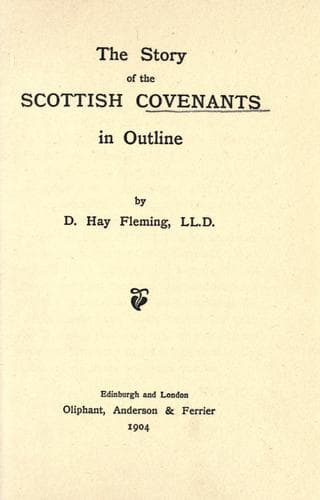
The Story of the Scottish Covenants in OutlineFleming, David Hay
History
The Story of the Scottish Covenants in Outline
Fleming, David Hay
Covenanters; Covenanters -- Scotland -- History; Covenants (Church polity); Scotland -- Church history
Of Montrose’s army, Patrick Gordon, a royalist, wrote: “When God had
given there enemies into there handes, the Irishes in particulare ware
too cruell; for it was everiewhere observed they did ordinarely kill all
they could be maister of, without any motion of pitie, or any
consideration of humanitie: ney, it seemed to them there was no
distinction betuixt a man and a beast; for they killed men ordinarly
with no more feilling of compassion, and with the same carelesse neglect
that they kill ane henn or capone for ther supper. And they were also,
without all shame, most brutishlie given to uncleannes and filthie lust;
as for excessive drinkeing, when they came where it might be had, there
was no limites to there beastly appetites; as for godlesse avarice, and
mercilesse oppression and plundering or the poore laborer, of those two
cryeing sinnes the Scotes ware alse giltie as they.”
[Sidenote: Retaliation]
The same writer tells how the Irish were repaid for their cruelty by the
victorious army of David Leslie at and after the battle of Philiphaugh
(13th September 1645); and how their sin was then visited, not only upon
themselves, but most brutally and pitilessly upon their wives and
followers.[4]
-----
Footnote 4:
The various accounts of the slaughter are rather contradictory in
their details. It may be noted, too, that—while Patrick Gordon says
that fifty Irishmen were promised safe quarter and yet were killed—it
was urged, in defence of the four prisoners condemned by the Scottish
Parliament, that the quarter they had received was not against the
orders of the Commander-in-Chief at Philiphaugh, as he only forbade
the giving of quarter to the Irish. Nearly a year before (24th October
1644) the English Parliament had declared that “no quarter shall be
given hereafter to any Irishman, nor to any Papist whatever born in
Ireland, which shall be taken in hostility against the Parliament,”
either on the sea or in England or in Wales; and ordained that they
should be excepted “out of all capitulations, agreements or
compositions,” and when taken should be forthwith put to death. The
massacres of 1641-1642 had not been forgotten.
[Sidenote: The Engagement]
Public-domain text, read in full here on John Shaqi.
Reviews
Reviews
No reviews yet
Be the first to share your thoughts on this work.
Join the Discussion
Join the discussion
Sign in to leave a comment or review.
Sign InorCreate an account