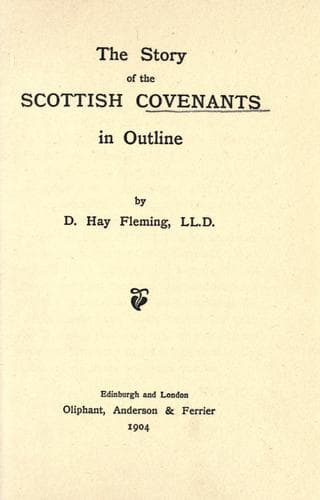
The Story of the Scottish Covenants in OutlineFleming, David Hay
History
The Story of the Scottish Covenants in Outline
Fleming, David Hay
Covenanters; Covenanters -- Scotland -- History; Covenants (Church polity); Scotland -- Church history
The Scottish Convention of Estates, professedly regarding field
conventicles as “rendezvouses of rebellion” with which the ordinary
military forces could not successfully cope, and desiring that the
“rebellious and schismatick principles may be rooted out by lawfull and
sutable means,” resolved, in July 1678, to offer the King £1,800,000
Scots, for securing the kingdom against foreign invasion and intestine
commotions. The payment was to be spread over five years, and the money
raised by five months’ cess in each of these years. Many Covenanters
denounced the paying of this cess as an active concurring with the
Lord’s enemies in bearing down his work. Some, however, thought it
better to pay than to furnish the unscrupulous collectors with a pretext
for destroying their goods, and extorting more than was due. The cess
thus became a cause of division, as well as an instrument of oppression.
[Sidenote: Sharp’s Death]
The hated Sharp fell into the hands of nine Covenanters at Magus Muir on
the 3rd of May 1679. Seven of the nine had no misgivings as to what they
should do in the circumstances; and they unscientifically butchered him
in presence of his servants and daughter. For that deed none were
responsible save those who were there; but many were afterwards brought
to trouble for it, and not a few, who were perfectly innocent, chose to
suffer rather than brand it as murder.
[Sidenote: Bothwell Bridge]
Some of those who took an active part in the tragedy of Magus Muir were
present at Rutherglen, on Thursday, the 29th of May, when the bonfires
which had been kindled in honour of the King’s birthday were
extinguished, and when the Act Rescissory and other obnoxious Acts were
publicly burned. On Saturday, Claverhouse set out from Glasgow to make
some investigations concerning this outrage, and next morning he
attempted, but in vain, to disperse an armed conventicle at Drumclog. On
this occasion he added nothing to his military reputation; and fled from
the field as fast as his wounded charger could carry him. Three weeks
later (22nd June 1679) the Covenanters, divided in counsel and badly
officered, were slaughtered by hundreds at Bothwell Bridge; and the
thousand and more prisoners who were taken were shut up in Greyfriars
church-yard, Edinburgh. Some of these prisoners were executed; some
escaped; many, after lying for weeks in the open church-yard, were
induced to purchase their release by binding themselves never to carry
arms against the King or his authority; and two hundred, after enduring
sufferings worse than death, were drowned next December off the coast of
Orkney.
[Sidenote: Cameronians]
Public-domain text, read in full here on John Shaqi.
Reviews
Reviews
No reviews yet
Be the first to share your thoughts on this work.
Join the Discussion
Join the discussion
Sign in to leave a comment or review.
Sign InorCreate an account