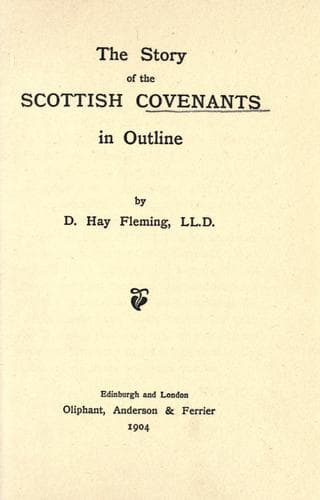
The Story of the Scottish Covenants in OutlineFleming, David Hay
History
The Story of the Scottish Covenants in Outline
Fleming, David Hay
Covenanters; Covenanters -- Scotland -- History; Covenants (Church polity); Scotland -- Church history
That this might not be a dead letter, a reward of five hundred merks was
offered to any one who captured a holder of, or convocater to,
field-conventicles; and these captors were not to be punished for any
slaughter that might be committed in apprehending such delinquents. Even
with such a law hanging over their heads, the faithful Covenanters were
not prepared to give up their conventicles. The Word of Life was much
too precious to be thus parted with. They did not intend, however, to
permit the oppressors to drive them or their preachers as lambs to the
slaughter, and so they henceforth carried arms for defence.
[Sidenote: Public Worship]
As no general attempt had been made, since the Restoration, to alter the
services of the Church, save to a very slight degree, the worship of
Conformists and Nonconformists was practically the same. Now, however,
“many Conformists began to dispute for a liturgy and some to preach for
it; but the fox Sharp was not much for it, only because he had no will
to ride the ford where his predecessor drowned.”
[Sidenote: James Mitchell]
An unsuccessful attempt to rid the country of Sharp had been made in
1668 by James Mitchell, who several years afterwards was apprehended;
but no proof could be adduced against him, until, on the Lord
Chancellor’s promise to save his life, he confessed. The Chancellor and
Treasurer-Depute swore that they heard him make his confession before
the committee; Lauderdale and Sharp swore that they heard him own it
before the Privy Council. They denied all knowledge of any promise of
life, although the promise had been duly minuted; and the request of
Mitchell’s advocates, that the Register of the Privy Council should be
produced, or the clerks obliged to give extracts, was rejected; and the
prisoner was sentenced to be hanged.
In Lord Fountainhall’s opinion, this was one of the most solemn criminal
trials that had taken place in Scotland for a hundred years; and it was
generally believed that the law was strained to secure a conviction. He
adds: “It was judged ane argument of a bad deplorat cause that they
summoned and picked out ane assysse [_i.e._, a jury] of souldiers under
the King’s pay, and others who, as they imagined, would be clear to
condemne him.” The Privy Council would have granted a reprieve, but
Sharp would not consent. On him was laid the chief blame of Mitchell’s
torture in 1676 and execution in 1678.
[Sidenote: The Ladies’ Covenant]
According to Dr Hickes, several ladies of great quality, in January
1678, kept a private fast and conventicle in Edinburgh, to ask God to
bring to nought the counsels of men against his people; and before they
parted they all subscribed a paper, wherein they covenanted, to the
utmost of their power, to engage their lords to assist and protect God’s
people against the devices taken to reduce them to order and obedience.
Next month the Highland Host plundered covenanting Ayrshire and
Clydesdale.
[Sidenote: The Cess]
Public-domain text, read in full here on John Shaqi.
Reviews
Reviews
No reviews yet
Be the first to share your thoughts on this work.
Join the Discussion
Join the discussion
Sign in to leave a comment or review.
Sign InorCreate an account