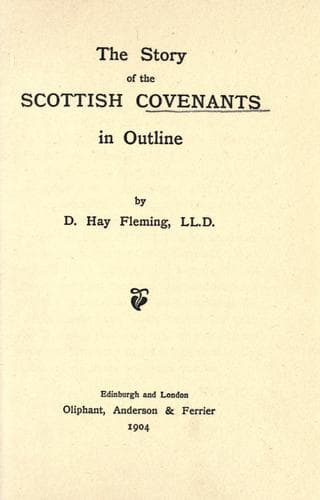
The Story of the Scottish Covenants in OutlineFleming, David Hay
History
The Story of the Scottish Covenants in Outline
Fleming, David Hay
Covenanters; Covenanters -- Scotland -- History; Covenants (Church polity); Scotland -- Church history
In speaking of his own preaching in 1556, Knox tells that, at that time,
most of the gentlemen of the Mearns “refuissed all societie with
idolatrie, and _band thame selfis_, to the uttermost of thare poweris,
to manteane the trew preaching of the Evangell of Jesus Christ, as God
should offer unto thame preachearis and oportunitie.” Dr M‘Crie
understood this to mean that these gentlemen “entered into a solemn and
mutual bond, in which they renounced the Popish communion, and engaged
to maintain and promote the pure preaching of the Gospel, as Providence
should favour them with opportunities.” In David Laing’s opinion, Knox’s
words do not necessarily imply that the mutual agreement or resolution
referred to actually assumed the form of a written “band” or covenant.
If it did, Knox has not embodied it in his “History,” nor is any copy
known to exist.
[Sidenote: Band of 1557]
But as to the reality, the nature, and the precise date of the band of
1557, there is no room for dubiety. Knox was on the Continent when it
was entered into; but he relates the circumstances which called it
forth, explains the object it was meant to serve, and gives a copy of
the document itself, as well as the names of the principal men who
signed it. The leaders of the Reforming party resolved to persist in
their purpose, to commit themselves and their all into God’s hands,
rather than allow idolatry manifestly to reign, rather than suffer the
subjects of the realm to be defrauded as they had been of the preaching
of Christ’s Evangel. “And that everie ane should be the more assured of
other, a commoun band was maid, and by some subscrived.”
Calderwood derived his copy of the document, and his account of the
circumstances which called it forth, from Knox. Fully forty years ago an
original copy of the band was found, and is now in the National Museum
of Antiquities, Edinburgh. It only bears five signatures, those of
Argyll, Glencairn, Morton, Lorne, and John Erskine. The day of the month
is left blank; but the one which Knox followed is dated “the thrid day
of December.” Knox also says that it was subscribed by many others. The
explanation probably is that (as in 1638) a number of original copies
were made, and signed by the leaders before being sent out for
additional names.
Public-domain text, read in full here on John Shaqi.
Reviews
Reviews
No reviews yet
Be the first to share your thoughts on this work.
Join the Discussion
Join the discussion
Sign in to leave a comment or review.
Sign InorCreate an account