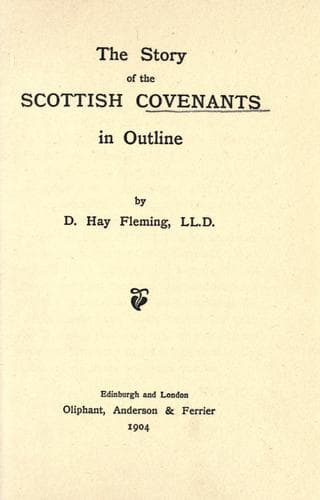
The Story of the Scottish Covenants in OutlineFleming, David Hay
History
The Story of the Scottish Covenants in Outline
Fleming, David Hay
Covenanters; Covenanters -- Scotland -- History; Covenants (Church polity); Scotland -- Church history
This band of 1557, like those of a later date, is remarkable for the
clearness, the directness, and the vigour of its language, but unlike
them it can hardly be regarded as a public document. To have exhibited
it then to all and sundry would have been to court persecution, perhaps
death. “To those who agreed with them,” says Buchanan, “they presented
bonds for their subscription. These first assumed the name of ‘the
Congregation,’ which those who followed afterward rendered more
celebrated.” Although there are barely two hundred and fifty words in
the band of 1557, the Protestant party is mentioned in it seven times as
the Congregation. It was nearly five months after the date of this band
before Walter Mill was consigned to the flames.
[Sidenote: Bands of 1559]
The year 1559 was rendered notable in Scotland by the return of Knox, by
the open rupture between the Congregation and the Queen Regent, and by
the rapid progress of Protestantism. In the summer of that year the
Reformers deemed it advisable to enter into at least three distinct
covenants, their respective dates being the 31st of May, the 13th of
July, and the 1st of August. None of the originals of these is known to
have survived, but copies of all the three have been preserved. They had
for their general object the advancement of the Reformation, but each
had its own distinctive traits and special end. The first was entered
into at Perth, the second at Edinburgh, and the third at Stirling. The
second was adopted in St Andrews as the “letteris of junctioun to the
Congregatioun,” and as such was taken by more than three hundred
persons.
[Sidenote: Rupture of French Alliance]
Not the least striking result of the Reformation was the complete
bursting up of the ancient alliance between France and Scotland, and the
drawing together of Scotland and England—that England which Scotland had
so long and so recently regarded as its “auld enemy.” The importance of
this result is frankly acknowledged by Teulet, one of the most
competent, careful, and candid of French historical students. He puts
the matter thus: “Scotland, which was for so many ages the devoted ally
of France, the rein, as our ancient kings said, with which they
restrained the encroachments of England, was unwilling to abdicate its
nationality and become a French province. Moreover, the unbridled
excesses of the French troops in Scotland, no less than the shameless
rapacity of the French agents, at last aroused a general spirit of
resistance, and England soon found in the rupture of the ancient
alliance between France and Scotland an ample indemnification for the
loss of Calais.”
[Sidenote: French Excesses]
Public-domain text, read in full here on John Shaqi.
Reviews
Reviews
No reviews yet
Be the first to share your thoughts on this work.
Join the Discussion
Join the discussion
Sign in to leave a comment or review.
Sign InorCreate an account