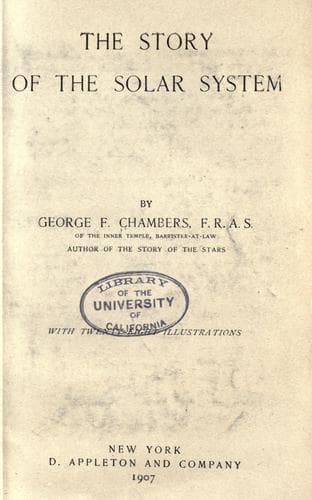
The Story of the Solar SystemChambers, George F. (George Frederick)
Science
The Story of the Solar System
Chambers, George F. (George Frederick)
Solar system
To an amateur possessed of a small telescope, the Sun offers (when the
weather is above the English average of recent years) a very great and
constant variety of matters for studious scrutiny in its so-called
“spots.” To the naked eye, or even on a hasty telescopic glance, the Sun
presents the appearance of a uniform disc of yellowish white colour,
though often a little attention will soon result in the discovery of a
few, or it may be many, little black, or blackish patches, scattered
here and there over the disc seemingly without order or method. We shall
presently find out, however, that this last-named suggestion is wholly
inaccurate. Though commonly called “spots,” these dark appearances are
not simple spots, as the word might imply, for around the rather black
patch which constitutes generally the main feature of the spot there is
almost invariably a fringe of paler tint; whilst within the confines of
the black patch which first catches the eye there is often a nucleus or
inner portion of far more intense depth of shade. The innermost and
darkest portion being termed the _nucleus_, the ordinary black portion
is known as _umbra_, whilst the encompassing fringe is the _penumbra_.
It is not always the case that each individual umbra has a penumbra all
to itself, for several spots are occasionally included in one common
penumbra. And it may further be remarked that cases of an umbra without
a penumbra and the contrary are on record, though these may be termed
exceptional, often having relation to material organic changes either
just commencing or just coming to a conclusion. A marked contrast
subsists in all cases between the luminosity of the penumbra and that of
the general surface of the Sun contiguous. Towards its exterior edge the
penumbra is usually darker than at its inner edge, where it comes in
contact with the umbra. The outline of the penumbra is usually very
irregular, but the umbra, especially in the larger spots, is often of
regular form (comparatively speaking of course) and the nucleus (or
nuclei) of the umbra still more noticeably partakes of a compactness of
outline.
Spots are for the most part confined to a zone extending 35° or so on
each side of the solar equator; and they are neither permanent in their
form nor stationary in their position. In their want of permanence, they
are subject, apparently, to no definite laws, for they frequently appear
and disappear with great suddenness.
Public-domain text, read in full here on John Shaqi.
Reviews
Reviews
No reviews yet
Be the first to share your thoughts on this work.
Join the Discussion
Join the discussion
Sign in to leave a comment or review.
Sign InorCreate an account