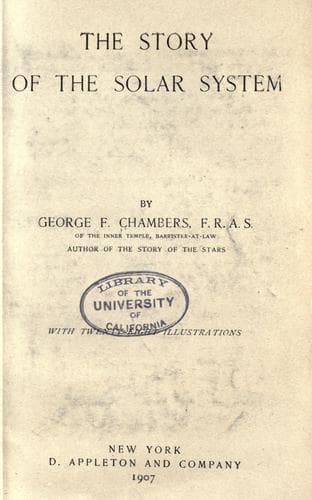
The Story of the Solar SystemChambers, George F. (George Frederick)
Science
The Story of the Solar System
Chambers, George F. (George Frederick)
Solar system
Their motions are evidently of a two-fold nature; the Sun itself rotates
on its axis, and the spots collectively participate in this movement of
rotation; but over and above this it has been conclusively proved that
sometimes a spot has a proper motion of translation of its own
independently of the motion which it has in consequence of the Sun’s
axial rotation. Curiously enough, spots are very rare immediately under
the Sun’s equator. It is in the zone extending from 8° to 20° North or
South, as the case may be, that they are most abundant; or, to be more
precise still, their favourite latitude seems to be 17° or 18°. They are
often more numerous and of a greater general size in the northern
hemisphere, to which it may be added that the zone between 11° and 15°
North is particularly noted for large and enduring spots. A gregarious
tendency is often very obvious, and where the groups are very straggling
an imaginary line joining the extreme ends of the group will generally
be found more or less parallel to the solar equator; and not only so,
but extending a long way, or sometimes almost entirely, across the whole
of the visible disc. With respect to the foregoing matters Sir John
Herschel remarked:—“These circumstances ... point evidently to physical
peculiarities in certain parts of the Sun’s body more favourable than in
others to the production of the spots, on the one hand; and on the
other, to a general influence of its rotation on its axis as a
determining cause in their distribution and arrangement, and would
appear indicative of a system of movements in the fluids which
constitute its luminous surface; bearing no remote analogy to our
trade-winds—from whatever cause arising.” More often than not when a
main spot has a train of minor spots as followers that train will be
found extending eastwards from the east side of the spot, rather than in
any other direction.
Spots remain visible for very diverse lengths of time, from the extreme
of a few minutes up to a few months; but a few days up to, say, one
month, may, in a general way, be suggested as their ordinary limits of
endurance. As the Sun rotates on its axis in 25¼ days, and as the spots
may be said to be, practically speaking, fixed or nearly so with respect
to the Sun’s body, no spot can remain continuously visible for more than
about 12½ days, being half the duration of the Sun’s axial rotation.
Public-domain text, read in full here on John Shaqi.
Reviews
Reviews
No reviews yet
Be the first to share your thoughts on this work.
Join the Discussion
Join the discussion
Sign in to leave a comment or review.
Sign InorCreate an account