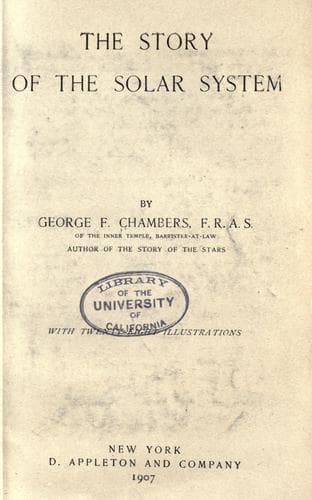
The Story of the Solar SystemChambers, George F. (George Frederick)
Science
The Story of the Solar System
Chambers, George F. (George Frederick)
Solar system
With regard to their size, spots vary as much as they do in their
duration. The majority of them are telescopic, that is, are only visible
with the aid of a telescope; but instances are not uncommon of spots
sufficiently large to be visible to the naked eye. The ancients knew
nothing about the physical constitution of the Sun, and their few
allusions to the subject were mere guesses of the wildest character.
They were, however, able to notice now and then that when the Sun was
near the horizon certain black spots could sometimes be distinguished
with the naked eye, but they took these for planets in conjunction with
the Sun, or phenomena of unknown origin. Earliest in point of date of
those who have left on record accounts of naked eye sun-spots are
undoubtedly the Chinese. In a species of Cyclopædia ascribed to a
certain Ma-touan-lin (whose records of comets have been of the greatest
possible use to astronomers), we find an account of 45 sun-spots seen
during a period of 904 years, from 301 A. D. to 1205 A. D. In order to
convey an idea of the relative size of the spots, the observers compared
them to eggs, dates, plums, etc., as the case might be. The observations
often extended over several days; some indeed to as many as ten
consecutive days, and there seem no grounds for doubting the
authenticity of the observations thus handed down to us. A few stray
observations of sun-spots were recorded in Europe before the invention
of the telescope. Adelmus, a Benedictine monk, makes mention of a black
spot on the Sun on March 17, 807. It is also stated that such a spot was
seen by Averröes in 1161. Kepler himself seems to have unconsciously
once seen a spot on the Sun with the naked eye, though he supposed he
was looking at a transit of the planet Mercury. None of these early
observers have told us the way in which they made their observations,
but the smallest of boys who has any claim to scientific knowledge is
aware of the fact, that by the use of so simple an expedient as a piece
of glass blackened with smoke, spots which are of sufficient size can be
seen with the naked eye. Before telescopes came into use it was
customary to receive the solar rays in a dark chamber through a little
circular hole cut in a shutter. It was thus that J. Fabricius succeeded
in December 1610 in seeing a considerable spot and following its
movement sufficiently well to enable him to determine roughly the period
of the Sun’s rotation.
Public-domain text, read in full here on John Shaqi.
Reviews
Reviews
No reviews yet
Be the first to share your thoughts on this work.
Join the Discussion
Join the discussion
Sign in to leave a comment or review.
Sign InorCreate an account